


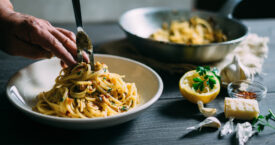
Sangiovese is the ideal wine for pizza, lasagne and bolognese
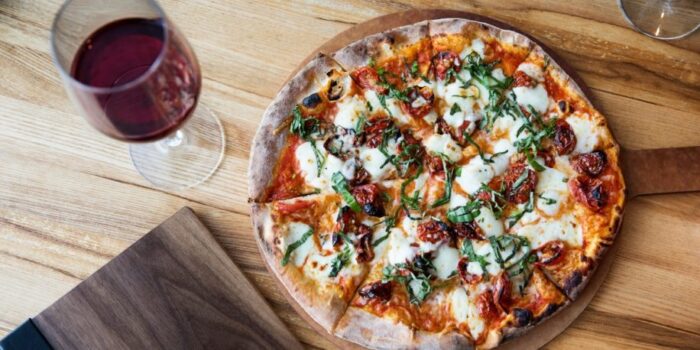
The ideal wine for pasta bolognese, lasagne and pizza exists! Its name? Sangiovese. Naturally, it’s an Italian wine, because what grows together goes together. Curious why the pairing is so wonderful and what flavours you can expect? I’ll tell you all about it!

From Chianti to Super Tuscan
You’ll find the Sangiovese grape in abundance among the rolling hills of Tuscany. That’s where exciting, world-famous bright red wines are made: from the once-studenty Chianti, packaged in wicker-covered bottles, to the finest Super Tuscans, which rival the most expensive red wines from Bordeaux. Sangiovese is also produced outside Italy, including in Argentina and the United States.
Typical Sangiovese
How can you recognise a wine made from Sangiovese? First, the colour: they are beautifully garnet red. Then there are the aromas: red cherries, sweet spices (such as cinnamon), strawberry, riper fruit, leather, dried flowers, sometimes something earthy (think forest floor) and dried tea leaves. Finally, Sangiovese wines have refreshing acidity, fine tannins and some bitterness.
Quality and styles of Sangiovese
It takes some study to get to know the different quality classifications and styles of Sangiovese wines. To keep things clear, I divide most of them into three categories: Toscana IGT (Indicazione Geografica Tipici), Chianti—whether Classico or not—and Montepulciano & Montalcino.
Fiasco
After the Second World War, winegrowers in Tuscany produced masses of Chianti. The famous wicker-covered bottles containing the wine hung from the ceilings of pizzerias everywhere. Equipped with a dripping candle, the empty bottle also found its way into many student rooms. You might almost say, ‘Chianti—who didn’t grow up with it?’ The quantity was enormous, but the quality of the wine was mediocre. And to top it all off, the Italian name for a wicker-covered bottle is also ‘fiasco’…
Fortunately, the tide has turned! You rarely see a fiasco in the Netherlands these days, and the wine has become much tastier: the very best wines come from the strictly controlled DOCG Chianti (Denominazione di Origine Controllata e Garantita, the highest Italian classification) and DOCG Chianti Classico. A bottle of Chianti Classico is immediately recognisable by the image of a black rooster, the ‘Gallo Nero’.
Super Tuscan
You’ve probably heard of Super Tuscans. They are true cult wines that received their nickname in the early 1970s, when the now world-famous wines Sassicaia and Tignanello entered the Tuscan scene. Because these wines contained French grapes in the blend, such as Cabernet Sauvignon and Cabernet Franc, and were therefore not made solely from Italian grapes, they did not qualify for DOCG or even DOC status. They entered the market as simple Vino da Tavola: ‘table wine’.
All the more surprising, then, is the unparalleled quality of these wines. Hence the name ‘Super Tuscan’, and they became genuine cult wines with hefty price tags. In the meantime, some of these wines do fall under the DOC or DOCG classification. There are also producers who stick with the IGT classification introduced in the 1990s. Toscana IGTs are wines that may be produced throughout the region from Sangiovese, optionally supplemented to a greater or lesser extent with other grapes.
World-famous wine villages
Then there are the villages of Montalcino and Montepulciano, which produce Sangiovese wines. As early as the Middle Ages, the wines of Montepulciano were favourites among the nobility. Hence the evocative name: Vino ‘Nobile’ di Montepulciano. And you won’t find the name ‘Sangiovese’ in Montalcino; there, it’s called ‘Brunello’. The label therefore reads: Brunello di Montalcino. The grape is the same, but the style is very different from Chianti. A good Brunello di Montalcino is full-bodied and concentrated, with a broad range of flavours and aromas. A Chianti is fresher.
What else can we eat with it?
Sangiovese wines pair beautifully with a range of Italian dishes. This wine loves tomatoes, hence the pasta bolognese, lasagne and pizza. Dishes with mushrooms also work well. The richer styles are perfect partners for meat (lamb, game, bistecca alla fiorentina) and hard cheeses (Pecorino, Parmesan). Also delicious: Sangiovese with polenta and sausages.
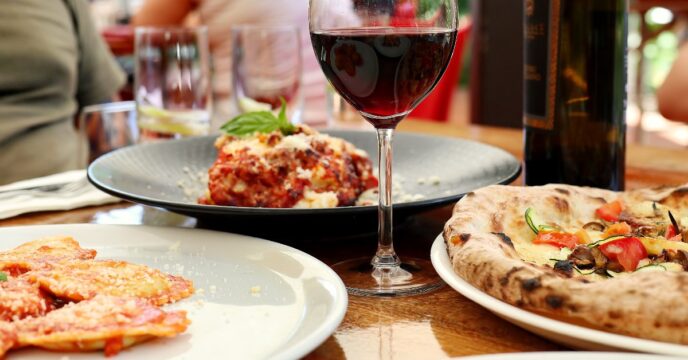
Serving you: three knockout wines, increasing in price.
Chianti docg ‘Sensi’ € 4,99
A wine that smells of the Portuguese cherry liqueur ‘Ginja’. Lots of cherries! Very easy to drink, not particularly exciting, but very approachable. Drink it with a tasty garlic salami and pepperoni pizza. Available at Plus supermarkets, among others.
Sangiovese Rosato Rubicone igt ‘Filarino’, € 9,75
Cheerful label. A delicious light wine that, with your eyes closed, tastes like a white wine. Let those first rays of sunshine arrive! Then, pop open a delicious pasta salad with grilled tuna on the side, mmm! Careful, the bottle will be empty in no time. Available here, among other places.
Rosso di Montalcino doc ‘Castello Banfi’, € 19,95
Rosso is the approachable little brother of the top wine Montalcino. Don’t judge a book by it’s cover; this wine doesn’t rely on its looks. But the contents: this is soft, this is exciting, this is delicious! And still very approachable and easy to drink. A perfect wine with pasta bolognese or lasagne. La vita è bella! Available here, among other places.
Also read:


