



Savogniner Bergkäse: the ultimate Swiss stinky cheese
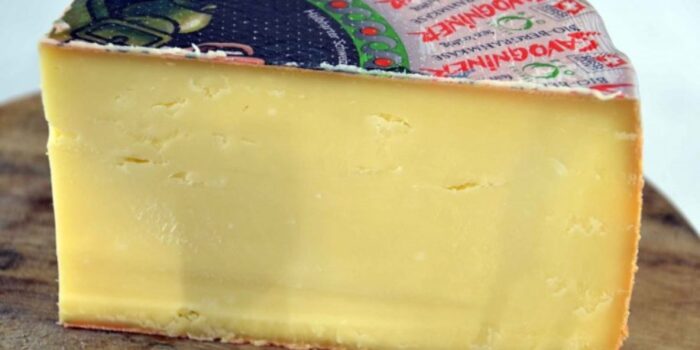
The sturdy character, a sharp taste and a smell that cannot be stopped. Swiss cheese from the mountains, FF’s Nora loves it and especially the Savogniner Bergkäse. So when on holiday in Switzerland, there’s nothing else to do but stop by the dairy in Savognin where this cheese is made. A pilgrimage for true cheese lovers.

In the small cheese factory overlooking the ski slopes, cheese is made under the inspiring leadership of Florian, a young man originally from Germany. Florian immediately tells us: “It was a warm autumn and now it isn’t really winter either. Just look around you, everything is green. Normally, you can ski everywhere here.” The consequence? Florian sells fewer cheeses in his shop next to the factory, because people only start making cheese fondue and eating raclette when it is nice and cold.
Master’s degree in cheesemaking
A German making Swiss cheese? Absolutely—and an incredibly delicious one at that. Florian first studies dairy technology in Germany at Mullermilch. He then completes a master’s degree in cheesemaking in France, where he meets his wife. Together, they decide to move to Switzerland because Florian is offered a job at the dairy there. Florian is a true cheese enthusiast with a passion for cheesemaking. “Not a day goes by without me eating cheese. Wherever cheese can be added, I add cheese.”
The cheese made at the dairy is Savogniner Bergkäse. What makes the cheese so special? The unique herb culture in Savognin, which you find only there and not in the valley. Various herbs grow in the grass in the mountains and are eaten by the cows. The cows also eat a mixture of hay, wet grass and corn. “You can taste that in the cheese,” says Florian. The recipe used for the cheese has remained the same for years. Occasionally, they experiment, as they are now with pine nut extract from the pine trees on the mountain. Florian still has to determine whether it will really taste good.
And he hasn’t even mentioned the penetrating smell yet, a mix of ammonia, disinfectant and cheese.
Physically and mentally demanding work
Eleven men work in the small factory, none of them from Savognin. According to Florian, that is because of the following: “A lot of the work in our production process is still done by hand. You have to be incredibly strong to handle this job, both physically and mentally. It is extremely hot and humid inside the factory, and noisy because of all the machines processing milk day and night.”
And he hasn’t even mentioned the penetrating smell yet, a mix of ammonia, disinfectant and cheese. Truly intense. According to Florian, that is why many young cheesemakers choose to work at the cheese factory in Chur, a city an hour away. Everything there is automated.
2,000 kilos of cheese
Every day, around 20,000 litres of fresh milk are brought from farms in the area around Savognin to the dairy and processed. That is enough to produce 2,000 kilos of cheese. Once the cheese is ready, it is matured in a cellar beneath the dairy. Around 12,000 pieces weighing approximately 5.5 kilos each are maturing there at a temperature of around twelve degrees. There is not enough room for all the cheese, so other caves and cellars in the area are used as well. In summer, a pipeline from the mountains supplies fresh cow’s milk from the two Alps surrounding the village. There is also less milk for Florian then, because the cows are pregnant when they head into the mountains in summer and therefore produce less milk.
The cheese is currently exported mainly to Austria and Germany, and soon to America as well, Florian proudly tells us. Fortunately, you can also buy it in the Netherlands at this supermarket and online, if you’ve become curious.


