


Street Food in Shanghai
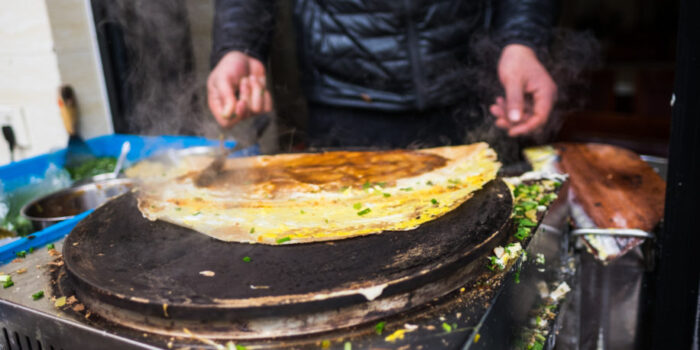
Street food: we can’t get enough of it. Fortunately, there’s still plenty of news to discover around the world. Every time, we travel to a different place. Today: Shanghai. The largest city in the country where you can perhaps eat the most deliciously and certainly the most diversely: China.

Xiao long bao
It’s undoubtedly not the first time you’ve read about these divine creations on FavorFlav. We admit it: we’re obsessed with soup dumplings and would happily eat them all day long. Xiao long bao are filled with broth containing lots of gelatin, which makes it set at room temperature. This way, you can easily fold it into the dumpling together with ground pork. When you heat it, the soup becomes liquid again. The most common variety is made with pork, but the variations are endless.
What is the difference between white and black pepper?
Sheng jian bao
Flavorful pork, wrapped in soft dough that is fried until crispy. These pork buns are traditionally served for breakfast in Shanghai, but they’re good at any time of day. They’re slightly larger than xiao long bao, about the size of a golf ball.
Shāo kǎo
Shāo kǎo is Chinese for ‘barbecue’, and you shouldn’t leave China before trying some. Everything is threaded onto skewers: from vegetables to pork liver and from chicken to seafood. Do pay attention to the quality. If you see the skewers being cooked fresh right in front of you, you know you’re in good hands. If they aren’t grilled fresh, there’s a chance they’ve been sitting around for a while. You obviously don’t want to get sick, because then you can’t keep eating.
-
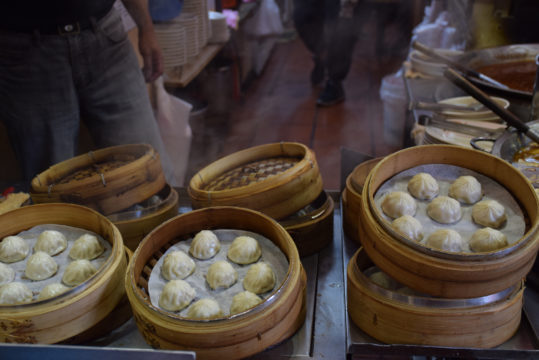
- Xiao long bao
-
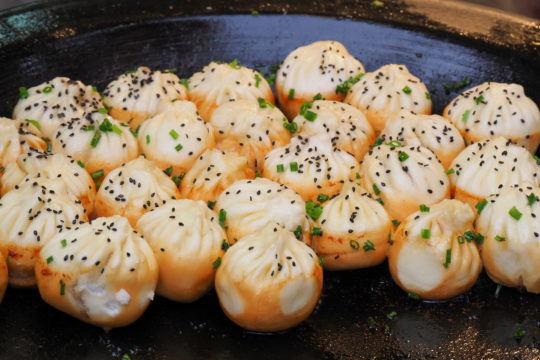

- Sheng jian bao
-
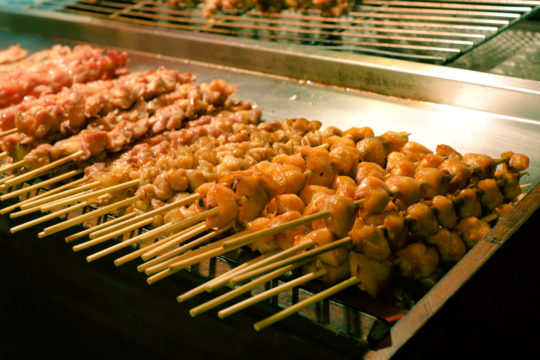
- Shāo kǎo
Ci fan tuan
If you see a long queue in the morning at a street food stall, ci fan tuan is probably being sold there. A soy-braised egg, pork floss, ground pork, brown bean sauce and a fried cruller are wrapped in a generous portion of sticky rice. The variety of flavors and textures will amaze you. The bean sauce is salty, the pork floss sweet, the cruller crispy and the rice creamy. You read that right: this is a breakfast for champions.
Cong you bing
Come rain or shine, locals (and you) queue for hours to get their hands on one of these fried, flaky and buttery scallion-and-pork pancakes. Fresh dough is rolled into a spiral and fried with caramelized scallions. The result? A crispy crust and flaky interior.
Jianbing
If you search YouTube for videos of Chinese street food, you’ll see jianbing in 90 percent of the videos you come across. It’s the Chinese combination of a crêpe and an omelet. The batter is spread thinly over a scorching-hot griddle and topped with thin strips of wonton, cilantro, scallions and pickles. The treat is finished with a generous amount of hoisin and chili sauce.
-
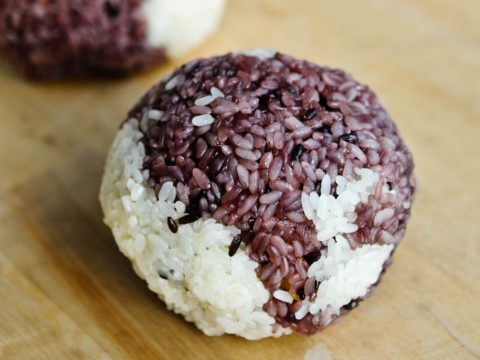

- Ci fan tuan
-
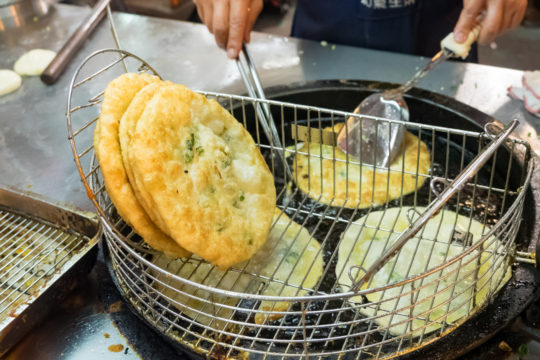
- Cong you bing
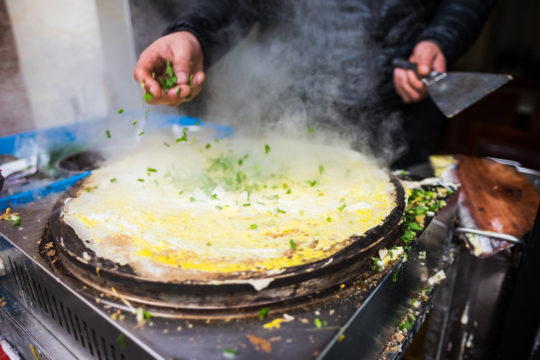
Pai gu nian gao
Pork chop braised in a sweet, sticky soy sauce, served on slippery rice cake. This Chinese specialty is often served around lunchtime, or later in the day with a cold beer.
Hongshao
Red cooking (hongshao) is something you see all over China. It’s a cooking method in which ingredients are slowly simmered in soy sauce with sugar and fermented bean paste. A common variation is pork belly slowly cooked this way. You’ll find it in all shapes and sizes: from street food to Michelin-starred restaurants.
Deep-fried anchovies
The ultimate on-the-go snack during a day in the city. You’ll find these deep-fried anchovies everywhere, and they’re nothing like the anchovies we know here—they’re at least three times as large.
Fried quail eggs
You’ll find this Chinese delicacy at the more authentic street food markets in Shanghai (Qibao & Zhujiajiao, for example). The quail eggs are fried on a skewer for two hours and then sold. Pop them into your mouth all at once.
-
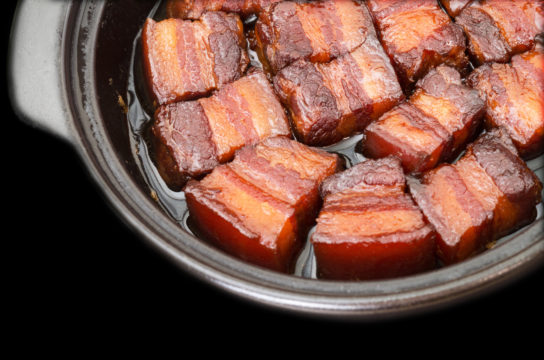

- Hongshao
-
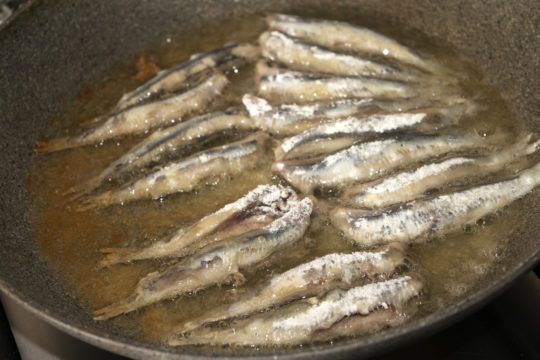
- Gefrituurde ansjovis
-
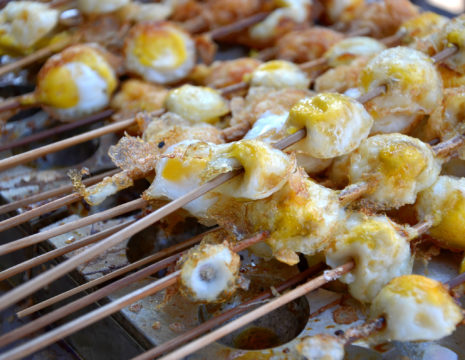

- Gebakken kwarteleitjes
Tangyuan
These sweet dumplings are made from glutinous rice and filled with sweet sesame or peanut brittle. This über-sweet dessert is mainly eaten by locals in winter and during Chinese New Year celebrations, but it’s made on the streets all year round. The shape of the dish has a traditional meaning: it represents togetherness within a family.
Shuāng pí nǎi
This delicate milk pudding traditionally comes from Guangdong province. The mixture of milk, white sugar and egg whites is steamed at a high temperature and is somewhat reminiscent of panna cotta. The result is a lightly sweet and creamy pudding, often topped with sweet red beans, goji berries and coconut milk.


