



The horror: a steak tartare with huge, hard chunks
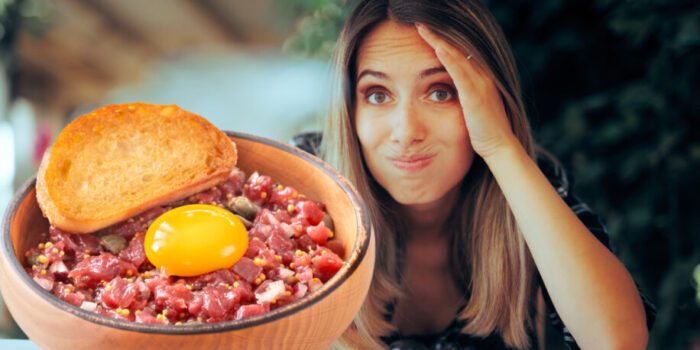
I know, steak tartare (or steak tartare) shouldn’t be too finely chopped, otherwise you might as well order a sandwich with filet americain. But steak tartare consisting of a pile of large chunks of cold beef is an insult to your taste buds and a challenge for your jaw muscles. Surely nobody wants that kind of horror on their plate?

Like at Harry’s Bar
Steak tartare. I don’t order it often, because raw meat. In principle, I’m not particularly wary of it, were it not for the fact that someone told me years ago about her tapeworm adventure after eating steak tartare. It took me a while to recover from that, and so it happened that for years I salivated at the thought of it but never ordered it.
Until recently. I saw it on the menu in Antwerp and gave in. Especially because, as I saw at neighboring tables, it was prepared so gezelligly at the table. And it wasn’t just any steak tartare, the menu promised. It was steak tartare as they serve it at the iconic Harry’s Bar in Venice! Hemingway, Orson Welles and Chaplin dined there. Apparently, the meat is finely chopped with a knife until it has a silky-smooth consistency. As a kind of prelude, I blissfully draped my napkin across my lap. Bring it on!
The steak tartare meat murder
The promise of a delicate dish, a symphony of freshly hand-cut rib eye, perfectly seasoned and silky-smooth in texture, prepared right in front of me—let’s go! In my enthusiasm—my salary had just been deposited and we were away for the weekend—I also ordered an extra portion of truffle for €16.
But what appeared on my plate a little later? A slaughterhouse of tough, half-chopped chunks of meat that you would expect to find in the drain of an abattoir on a desolate industrial estate rather than in a cozy restaurant with fine-dining pretensions. This wasn’t steak tartare. This was a meat murder topped with a little pubic hair made of truffle.
No food processor
With the first bite, I thought, ‘Stop whining, come on, an animal died for your enjoyment!’ And honestly, the taste wasn’t the problem. So I took another bite. While trying my hardest to enjoy the hand-cut rib eye and the extra €16, all I could think about was my poor intestines having to process these tough chunks. This wasn’t going well. Not only with my guts, but also not there in the kitchen. As if the chef had thought halfway through chopping: ‘You know what? Let them do the chewing themselves, I’m not a food processor—figure it out!’
The perfect balance between texture and creaminess
Meanwhile, I felt like the malfunctioning food processor myself, with this rough version that nearly caused me a jaw injury. This had nothing to do with what steak tartare is supposed to be: a perfect balance between texture and creaminess. Hand-cut, yes, but with precision: finely chopped enough to mix with the egg yolk, capers, shallot and herbs, but with just enough texture not to look like baby food. Good steak tartare melts on your tongue while still retaining a slight bite. You shouldn’t feel as though you’re re-chewing a tough cow.
Let’s be honest, coarse steak tartare is a culinary crime. It’s like someone serving you a cocktail with an entire lime in it. A bowl of vegetable soup with uncut onions. There’s a reason knives and cutting boards exist. Surely a good chef should understand that it’s not just about raw meat, but about the finesse with which it is prepared. The meat should be cut subtly, so that it absorbs all the flavors of the herbs and spices and combines effortlessly with classic additions such as capers, Worcestershire sauce, mustard, pepper and salt.
Just have a steak
So here’s a call to any chefs reading this: if you serve steak tartare, make sure it really is steak tartare. Not a plate full of chunks of meat that even the Flintstones would recoil from. Because let’s be honest: if you can’t make steak tartare properly, just serve a steak. At least then we can decide for ourselves how large to cut the pieces.
Tonight I’m making it myself. With BAUT’s famous steak tartare recipe, no less. Tip! And when you serve it, serve this anecdote alongside it too: Mongolian warriors (the Tatars) placed raw meat under their saddles to tenderize it during long journeys. This story is often linked to the origins of steak tartare, but there is little historical evidence for it. It does make a fun conversation piece, though.
Read also:


