


The Salty Black Gold
How two Taiwanese women began producing an almost forgotten traditional black soy sauce under the company name Wu Wan Wo (Forget Me Not), in order to share something from their homeland with the world. “A good soy sauce should bring out the flavor of the ingredients, never overpower it.”

This story begins in Amsterdam, when Gianni, owner of the Italian slow-food delicatessen shop Casa del Gusto, tells me about two Taiwanese slow-food members who make a traditional artisanal black soy sauce in their home country, one that is hardly produced anymore.
As it happens, I travel to Taiwan, and after some email correspondence I find myself sitting at a table in the heart of Taipei on a Tuesday afternoon with Carine Lin I-Chun, one of the two makers of Wu Wan Wo black soy sauce.
In front of Carine are three numbered bowls of soy sauce. And I am allowed to taste and guess. The first is salty, but also sugary sweet. It turns out to be an industrial soy sauce (which I of course immediately tasted). The other two are subtly salty. One has a somewhat deeper flavor, the other is feather-light: the two varieties of Wu Wan Wo.
Depending on the weather and sunlight, the jars remain outside for 180 days to two years.
Ming Dynasty
“Most soy sauces,” Carine explains as she braises Chinese cabbage for me to taste the sauce with it, “are made from yellow soybeans and wheat—the so-called Japanese style. Giovanna Chen and I use only black soybeans, following a tradition that dates back to the Ming Dynasty and, according to written sources, arrived in Taiwan in the sixteenth century. That is why our sauce is deep black, unlike the light-brown Japanese-style sauces. If those are black, too, you can be sure that coloring has been added. In addition, ours is gluten-free, because it contains no wheat.”
The fact that we are sitting here in Taipei, rather than in Central Taiwan where the sauce ferments, unfortunately, has a practical reason: fermentation takes place from March to September, when the sun is at its strongest. Because besides black soybeans and salt, sunlight is the most important ingredient. And even though it is around 18 degrees now, it is winter here.
Is the precise production process strictly secret, but roughly how does it work?
Carine, who studied in France and worked in marketing for fifteen years: “There are black soybeans for eating and special ones for making soy sauce. We buy them non-GMO and organic, and cook them. Then we add a natural family yeast, which starts the first fermentation. That is how the flavor of the sauce develops.”
“The beans are then placed in alternating layers with salt in a terracotta pot, which is put in the sun for the second fermentation. That is how the soy sauce is made. Each pot yields one hundred 250-ml bottles, with a total annual production of around 2,000 bottles. Depending on the weather and sunlight, the pots remain outside for 180 days to a year, and sometimes even two years.”
“Before we extract the soy sauce from the pots, we taste it to see whether it is sufficiently balanced. If necessary, we add a little brown sugar for a bit more balance.”
A good soy sauce should bring out the flavor of the ingredients, never overpower it
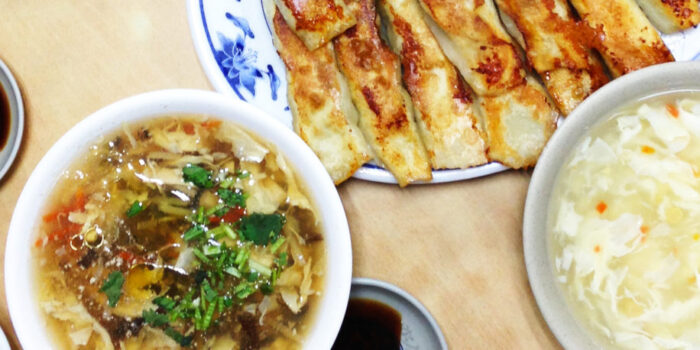
Wu Wan Wo produces two types of unfiltered sauce. One, harmonious, is intended for food that has already been prepared. From dumplings to scallion pancakes, which I later get to taste at Carine’s favorite Taipei dumpling stall. The richer-tasting sauce, called rich , is added to the food during preparation: for example, to braised meat. Or Chinese cabbage. Carine: “A good soy sauce should bring out the flavor of the ingredients, never overpower it.”
How did you acquire this knowledge? Did you learn it at home?
“No, we are two friends who love food. We wanted to introduce the world to a typical Taiwanese product that was on the verge of disappearing. Before we began, we conducted intensive research into the original preparation methods and apprenticed with various artisanal producers. Now Giovanna and I are among the few producers—perhaps there are no more than five left—who make soy sauce in this traditional way in Taiwan. Because the process is so time-consuming compared with industrial production, no one starts doing it anymore, and everyone thought we were crazy.”
At the end of the day, when we sit down for tea at Carine’s favorite teahouse, which has recently started serving black soy sauce cookies and rice wafers from Wu Wan Wo, she emphasizes that the value of their soy sauce lies in respecting the climate and connecting the flavors of East and West. “Soy sauce really isn’t just for Asian dishes. Thanks to Giovanna’s Italian contacts—she lives alternately here and in Trieste—more and more Italian (slow-food) chefs are using our sauce. On gourmet pizza, for example.”
Wu Wan Wo black soy sauce is available at Casa del Gusto in Amsterdam.
Image: Marjan Ippel


