


The ultimate empanada guide
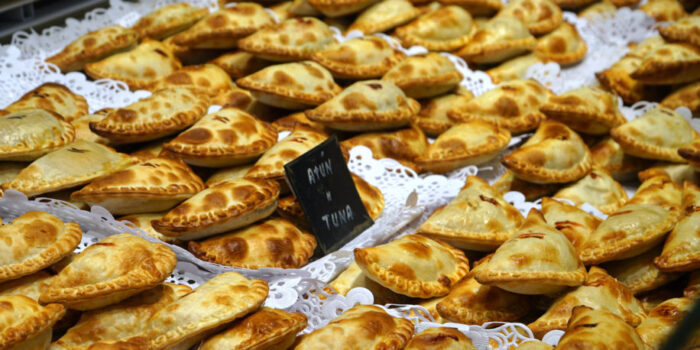
Empanadas can be found all over the world, but in many different shapes and with many different fillings. With this guide, you’ll recognize your fave snack from Bolivia to Italy. So you’ll never have to go without your favorite doughy treat again.

An empanada is dough filled with a savory filling that is baked or deep-fried. The name comes from the Spanish verb empenar, meaning to wrap or envelop. The origin of this savory snack isn’t entirely clear, but the doughy treat seems to have originated in Galicia, Spain, near the Portuguese border. From there, it is thought to have been transported to Argentina.
Spain and Portugal
In Portuguese cuisine, the savory snack is called a pasteis de carne or an empadas de carne. These pasteis or empadas vary considerably in terms of filling; they are filled with ground meat, chicken or pork. The same applies in Spain, where you’ll also find many different empanadas with various fillings.
In Galicia, however, you can identify a traditional empanada: here they make an empanada gallega, and this isn’t a small handheld empanada. It’s a large pie made with empanada dough and filled with tuna, tomato, onions and bell pepper.
Argentina
The best-known Argentine empanada is filled with a mixture of beef, onion, vegetables and sometimes egg and pieces of potato. Various peppers are often added to give it some heat. Other variations include delicious empanadas with ham and cheese, chicken or tuna. Empanadas de Humita are hugely popular in Argentina; they have a creamy corn filling. In Amsterdam, you can get authentic Argentine empanadas at BAIRES.
Cape Verde
In Cape Verde, you can see the Portuguese influence, and they love their pastéis. Here, they prefer fish: popular Cape Verdean pastéis are often filled with spicy tuna. These pastéis are also known as pastel com diabo dentro, meaning devilish fish pastéis. The name comes from the peppers mixed into the pastéis with the fresh tuna. They also incorporate their love of tuna into less spicy tuna pastéis: pastetus de atum.
Bolivia
Salteña is the juicy version of the empanada. Inside, the pastry is moist, like a stew made with chicken, beef or pork mixed with potatoes, vegetables and olives. This comes from making a stew out of all the ingredients with relatively much liquid, to which gelatin is added. This makes it firm in the refrigerator and allows it to melt slowly when the pastéis are baked.
So how are you supposed to eat these things without getting your new shirt covered in filling? There’s a trick: hold the salteña upright, nibble open the top, and eat the salteña bite by bite. It is a bit of a job to make, but if you’re up for it, here’s the recipe.
https://www.instagram.com/p/Bk-k1PXBc6M/
Chile
In Chile, the pastry is filled with ‘pino’. This is a mixture of beef, onion, garlic, black olives, raisins and boiled egg. Empanada de pino is truly a national snack that you can buy almost anywhere in Chile. The filling of this empanada is said to taste best when you make it a day in advance and only hide it in the dough the following day.
Indonesia
Indonesian toko shops are full of delicious snacks, but you really have to try the pasteitjes. These doughy snacks are filled with ground meat, vegetables, egg and sometimes glass noodles. Eat the snack with some hot chili sauce to finish it off, and stock up immediately, because these pastéis are available at all Indonesian toko shops.
Italy
This Southern Italian street food is a true Italian variation on the empanada: it’s a somewhat larger doughy snack filled with mozzarella and tomato. The panzerotti has exactly the same shape and is deep-fried, just like an empanada. A perfect cheesy, vegetarian variation, then. Want to try it? You can get the classic panzerotti at Panzero in Rotterdam.
Read also:


