


This is the difference between Japanese and Chinese tofu
Tofu is typically one of those dishes that you love or hate. Haters consider tofu the most overrated ingredient ever with a stupid texture, while fans love its neutrality, to which you can add loads of flavour. (Hello, just try making this ultimate tofu dish!) But this difference in texture does raise questions from time to time: why is one type of tofu so silky smooth while another is firm with a spongy appearance? And when you’re standing in front of the tofu section at such a great Asian supermarket, what exactly is the difference between Japanese and Chinese tofu?

Japanese versus Chinese tofu
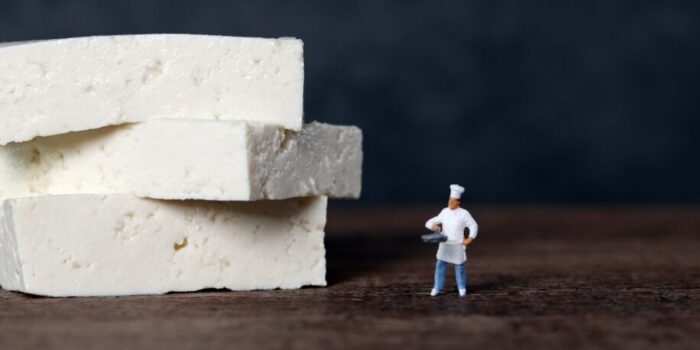
Food blogger Kip from Messy Vegan Cook explains it as follows: Tofu with the ‘harder’ texture—the tofu you also see in most Dutch supermarkets in the vegetarian section—is firm tofu, and on foreign packaging at the Asian supermarket it is often labelled ‘extra firm.’ This is also sometimes conveniently called Chinese tofu, because its firm texture makes it well suited to being tossed around in a wok at very high temperatures.
Press it firmly
Whichever way you prepare this firm ‘Chinese’ tofu, it is a good idea to press out as much moisture as possible first. Not necessarily by hand; I always wrap it in a clean tea towel (one that doesn’t smell of laundry detergent; every so often I do a wash with specially purchased fragrance-free detergent), place it in a deep plate and put my heaviest pan on top. After at least half an hour, the tofu is considerably drier and therefore much better able to absorb other flavours.
Chinese tofu
As Kip says, there are of course enormous regional differences in a country as large as China. But generally, calcium sulfate is used as a coagulant in the Chinese tofu-making process, giving it a somewhat chalkier texture.
Japanese tofu
Japanese tofu, which you often see at the Asian supermarket in packaging labelled ‘silken tofu,’ is made using the coagulant nigari—a kind of salt solution from seawater. This agent is also used in Chinese coastal regions, by the way. In any case, nigari does not produce the same chalky, lime-like texture, and with this production method the tofu remains softer and perhaps a little more ‘watery.’ That may not sound very appealing, but it can be delicious in, for example, ramen noodle soup. You just can’t go quite as wild with stir-frying and frying this tofu, because it falls apart easily.
Give it another try
Now that you know this, I would advise die-hard tofu haters to give it another chance. Maybe you had the wrong type of tofu for a specific preparation, or perhaps the tofu wasn’t dressed up enough with exciting sauces and spicy ingredients. But of course, it may also be that things will never work out between you and tofu. And in that case, we’ll just bond over a big plate of fries!
Also read:
- Tofu is the most overrated ingredient ever
- This ingredient makes tofu that actually tastes good
- 4 types of chips from the Asian supermarket you really want to try (and 1 to leave on the shelf)


