



Turkish dumplings with spiced chickpeas from the oven
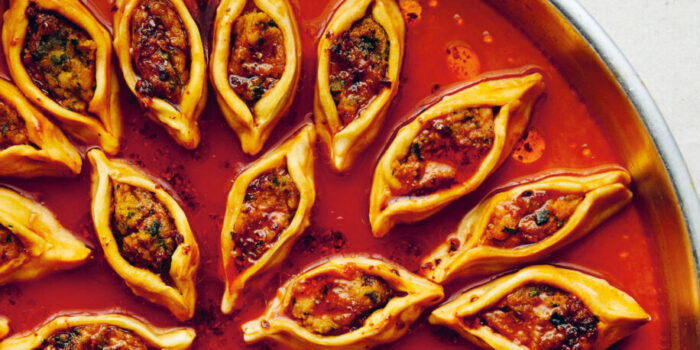
Turks love mantı. The word mantı is derived from mantou (Chinese) or mandu (Korean), meaning ʻdumplings’. There are many regional varieties of mantı (stuffed dumplings). It is a shared culinary heritage that nomadic Turkish tribes brought with them when they travelled from Central Asia to Anatolia in the 11th century. Traditionally, family members get together to make mantı at home. With this recipe from Ozlem Warren, you can do so too!

Ozlem: ‘I have fond memories of this ritual with my grandmother and parents in Istanbul, accompanied by tea, coffee and the latest gossip. Mantı with a meat filling is the most common, but we also make vegetarian versions. This boat-shaped variety is a speciality of Bilecik province in northwestern Anatolia and has a wonderfully spiced chickpea filling. This showstopper is baked in the oven and can be prepared in advance. The combination of the melt-in-your-mouth mantı boats with garlic yoghurt and herb oil is simply irresistible.’
How to make Turkish mantı boats
- First, make the dough. Sift the flour with the salt into a bowl and make a well in the centre. Pour the egg, water and olive oil into the well and mix with your hands until a dough forms. Knead for 3 to 4 minutes on a floured work surface until smooth and elastic. Cover with cling film and leave to rest in the refrigerator for 30 minutes.
- Meanwhile, make the filling. Heat the olive oil in a wide, heavy-based pan over medium heat, add the onion and fry for 10 to 12 minutes, until the onion is soft and begins to char. Stir in the chopped flat-leaf parsley and leave to cool.
- Place the chickpeas in a large bowl and remove any loose skins. Mash with a potato masher (I like to do this with my hands, but if you find that too strenuous, you can also use a food processor). Add the fried onion, ground cumin and pul biber, and season well with salt and pepper (this filling should be strongly seasoned). Knead everything together well with your hands for a few minutes.
- Grease a round baking dish measuring 40 cm in diameter or a square baking dish measuring 40 x 40 cm with olive oil (or use two smaller baking dishes). Preheat the oven to 200 °C.
- Divide the dough into three balls. Work with one ball of dough at a time (cover the rest with cling film so the dough does not dry out) and roll it out on a lightly floured work surface into a sheet measuring 30 x 24 cm. Cut the dough with a sharp knife into 6 cm squares. Place a generous 1⁄2 teaspoon of filling in the centre of each square and pinch the points together on both sides to form a boat and keep the filling in place (dip your fingers in a little flour if the dough becomes too sticky). Repeat with the remaining dough and filling, and arrange the mantı boats next to one another in a single layer in the baking dish.
- Bake in the oven for about 18 minutes, until the boats are lightly golden brown.
- For the garlic yoghurt, whisk the yoghurt with the garlic in a medium-sized bowl and season with salt. Cover and bring to room temperature.
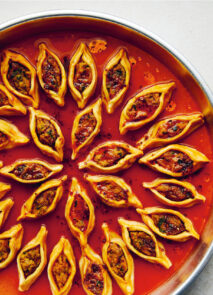
- Make the sauce while the mantı are in the oven. Heat the oil in a medium-sized pan, stir in the tomato purée, pour in the water and season with salt and pepper. Bring to the boil and turn off the heat.
- Pour the sauce around the baked mantı boats (a layer of approximately 5 mm) and bake for another 8 to 10 minutes in
the oven, until most of the sauce has been absorbed. Remove the baking dish from the oven and cover with aluminium foil. - For the herb oil, pour the olive oil into a small pan and stir in the pul biber and mint. Let infuse over low heat for 30 to 40 seconds, then turn off the heat.
- Place the mantı boats on a serving dish, spoon the garlic yoghurt over them and drizzle with the herb oil. Serve immediately.

Title: Sebze
Author: Ozlem Warren
Price: €32,50
Publisher: Good Cook
This colourful cookbook offers more than 85 versatile vegetarian dishes from the heart of Turkey. Sebze means ʻvegetableʼ in Turkish, derived from the Persian word sabze or sabzi, meaning ʻgreennessʼ. Sebze features both lesser-known regional specialities and popular Turkish recipes, such as stuffed aubergine, peppers with fragrant rice and Turkish shortbread cookies with pistachio.
Read also:


