



Want it now: pastéis de nata
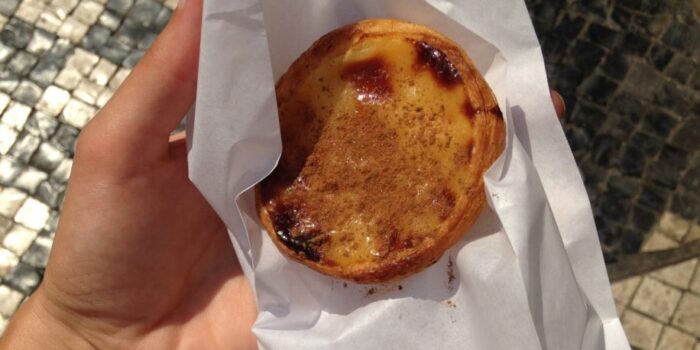
Two weeks of vacation in Portugal and I ate one or two almost every day, that’s how addictive pastéis de nata are.

Pastéis are made from crispy puff pastry and filled with creamy custard. The filling consists of a mixture of eggs, cream, sugar and vanilla. To finish, sprinkle some cinnamon on top.
History of pastéis de nata
The first pastel (singular of pastéis) was first made by the monks of the monastery ‘Mosteiro dos Jeronimos’ in Belém, a suburb of Lisbon. Due to a liberal revolution in 1834, all monasteries had to close, and in an attempt to make some money, the ‘dismissed’ monks sold the pastries as ‘Pastéis de Belem’ in a shop right next to the monastery.
Every day, there is an enormous queue at the shop, mainly made up of tourists who want to try the delicacy.
Pastéis de Belém
At that same location, Rua de Belém 84, the Pastéis have now been baked for almost two hundred years according to the monks’ original recipe. Every day, there is an enormous queue at the shop, mainly made up of tourists who want to try the delicacy.
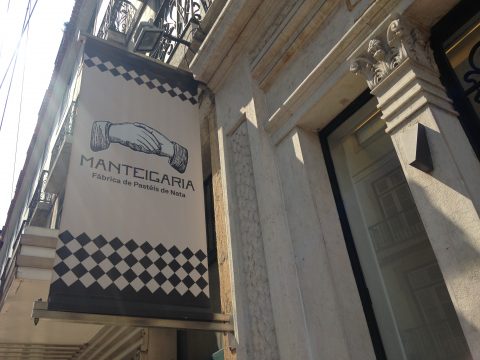
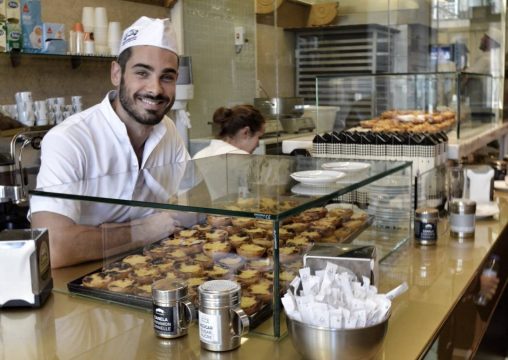
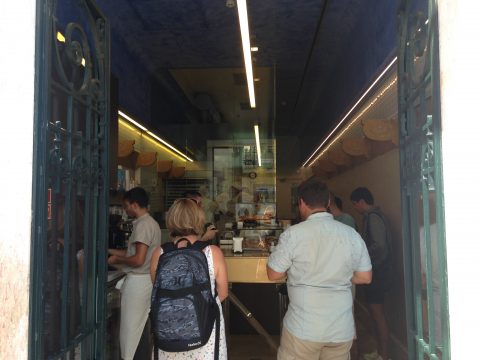
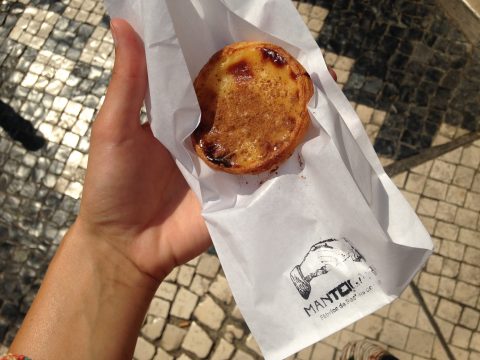
Of course, you don’t necessarily have to go to Belém. In Portugal, you can buy them at virtually every bakery and coffee shop. They are simply not called Pastéis de Belém, but pastéis de nata, because only the pastries from Belém may be called that. Every pastry shop has its own recipe, and they are all equally delicious, as long as they are fresh that day. Among other places, I ate them at Manteigaria, a small bakery in Lisbon that sells only pastels and coffee.
Manteigaria
Where to buy them in the Netherlands
No trip to Portugal on the horizon? Don’t despair.
Amsterdam
A Loja (Hendrik Jacobszstraat 14)
Casa Bocage (Haarlemmerstrat 111)
Rotterdam
Paladar (Nieuwe Binnenweg 145 A)
De Bakkerswinkel (Schiedamse Vest 99 A)
Utrecht
De Bakkerswinkel (Wittevrouwenstraat 2)
The Hague
De Bakkerswinkel (Torenstraat 142)


