



What exactly is kosher salt?
If you ever cook with American recipes, you’ll probably recognize this. You want to try out a delicious new dish, and suddenly it says you need kosher salt. What is that supposed to be? FavorFlav brings clarity.

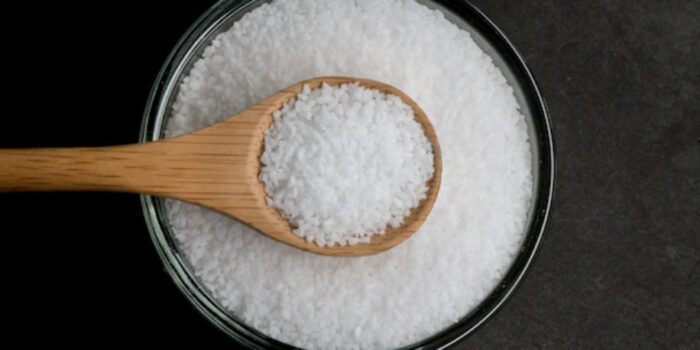
What makes salt kosher? The salt itself isn’t kosher, but it’s called that because Jews originally used it to draw blood from meat. That’s how they make the meat kosher. They aren’t allowed to eat blood, but they are allowed to eat the meat. For this, salt with a coarse, flaky grain is best suited, and that is exactly what kosher salt is. It doesn’t necessarily taste different from sea salt, but it has a different shape from regular table salt or coarse sea salt. In terms of texture, it falls somewhere between fleur de sel and coarse sea salt.
Replace it 1:1?
In terms of flavor, sea salt is the best substitute for kosher salt, but you need to be careful when your recipe specifies a fixed amount of kosher salt. A teaspoon of kosher salt can’t simply be replaced with a teaspoon of any other salt. Because the flakes of kosher salt are so flaky, there is more air between them than with fine table salt. As a result, a teaspoon of table salt is actually about twice as much as a teaspoon of kosher salt. And even different brands of kosher salt aren’t the same.
Salt to taste
Your food can turn out badly if you casually swap different types of salt. Fortunately, the solution isn’t very complicated. Serious Eats has created a table to convert kosher salt to table salt, Maldon sea salt or fleur de sel. If you add salt to taste to the recipe, it doesn’t matter all that much.
Pickling
But if you’re preserving or brining with salt and the recipe calls for kosher salt, it’s really important to use another type of coarse-grained salt. In that case, use half the amount of Maldon sea salt or the full amount of fleur de sel.
Buying it
It’s difficult to find in the Netherlands, but there are a few places, for example at Tjin’s Toko in Amsterdam or online.
Read also:


