


Where did beschuit met muisjes come from?
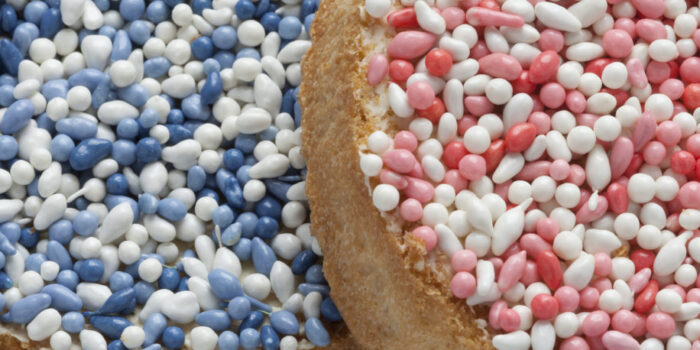
On Saturday, I was at a kraamfeest, or ‘baby shower’. Whatever you want to call it, one thing is always there: beschuit met muisjes. Why? I wondered, and above all: where did this quintessentially Dutch tradition come from?

Ineke Strouken was the director of the Nederlands Centrum voor Volkscultuur and the Kenniscentrum Immaterieel Erfgoed Nederland for 32 years. She wrote a book about Dutch traditions: Dit vieren wij, van Nieuwjaarsduik tot Knalfeest. The true origin of beschuit met muisjes is unclear, as her book reveals, but what we do know is that people were already eating muisjes in the eighteenth century to celebrate the birth of a new baby.
Treat
Why? People believed that aniseed stimulated breast milk production, so new mothers ate it to their heart’s content. This led to the tradition of serving beschuit met muisjes and a glass of kandeel (anise liqueur with, yes: 17% alcohol). The muisjes were created when bakers specially coated the seeds with a layer of sugar for mothers. They were sold as ‘anijsconfect’, but were also called aniseed sweets or mouse droppings.
The beschuit was added because people of status used to eat anise rusks with a glass of anise liqueur. The muisjes were probably sprinkled on top, giving rise to the beschuit met muisjes tradition.
Royal
‘The tradition only really gained national recognition in 1938, when Beatrix was born,’ Koninklijke De Ruijter’s marketing manager Valerie Spigt told RTL Z. ‘It was a major publicity stunt. A very large tin of orange geboortemuisjes was presented at Soestdijk Palace. This gave rise to a quintessentially Dutch tradition in which people in the Netherlands eat beschuit met muisjes when a baby is born.’ Aha, so we actually eat beschuit met muisjes because of a major marketing stunt.


