



Why you should always make ice cubes with boiling water (yes, really)
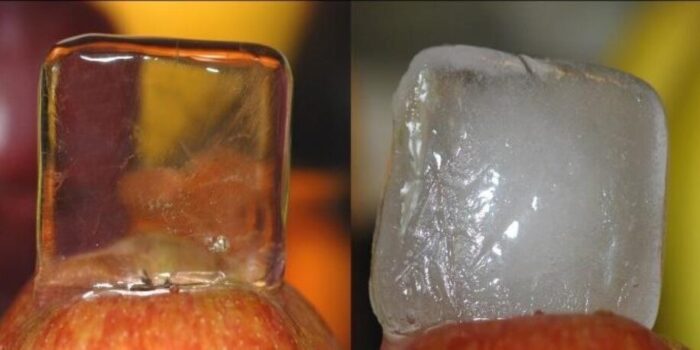
In the Today I Learned category, another gem from kitchen science has surfaced: the difference between ice cubes. And no, we’re not talking about cubes filled with fruit, gin or edible flowers (although those are great too). This time, it’s about the basics. Just: water. Because did you know that the temperature of the water makes a huge difference to the end result of your ice? Well, neither did we. But now we do. And we are flabbergasted.

Cold water = cloudy ice. Boiling water = crystal clear
Most people simply fill their ice cube tray with cold tap water. Easy enough, and logical too. But if you do that, you get those cloudy, milky-white cubes that look as though they’ve already been frozen three times over. Not exactly sexy, especially when you want to serve a beautiful cocktail or an ice-cold glass of whisky.
If, on the other hand, you use boiling water for your ice cubes, you suddenly get glass-clear, almost jewel-like cubes. Seriously, the difference is huge. And they look much more elegant in your glass.
Why does boiling water work better for ice cubes?
It sounds rather contradictory (especially if, like me, you never really paid attention during chemistry class): using hot water for something that needs to be frozen. But it works, and here’s why:
Hot water contains less dissolved air than cold water.
When water boils, air bubbles escape from it.
Less air = less chance of bubbles and crystals in the ice.
Result: smooth, transparent cubes without a cloudy haze.
Cold water, on the other hand, holds on to that air, causing it to freeze with all kinds of tiny air bubbles inside. And that is what makes your ice cloudy.
Extra cool: hot water freezes faster than cold water
And so it turns out that something which sounds like pure magic is actually hard science. There’s even a name for it: the Mpemba effect. Hot water often freezes faster than cold water. That’s because the molecules in hot water are already “organising” themselves in a way that more closely resembles how they behave in ice form.
So if you’re ever in a hurry and need ice cubes fast? Boil that water. The hotter, the faster.
Pro tip: skip tap water for extra-clear cubes
Want to do even better? Don’t just use tap water; use filtered or bottled water instead. Tap water is far from as clean as you might think (it contains, among other things, PFAS in our drinking water). And that can still make your ice slightly misty, even if you’ve boiled it. With bottled water, you get cubes so clear that you could even use them as reading glasses.
Hot is the new cold
So yes, we’ll say it again: for beautiful, professional, fancy AF ice cubes, use boiling water. It sounds strange, but it works. And it turns your gin and tonic into one from an equally fancy cocktail bar, rather than a prefab glass with cloudy ice cubes. They’re the kind of little upgrades in life that take hardly any effort but elevate your cocktail skills to the next level. Santé!
Also read:
- Dutch people don’t want to pay for tap water on a terrace
- Wow: this is how unhealthy water with powder or syrup really is
- Why does tap water taste different everywhere in the Netherlands?
Source and image: isr_Raviv/Instructables


