



Yet another slaughterhouse closed due to coronavirus contamination risk: how dangerous is contaminated meat?
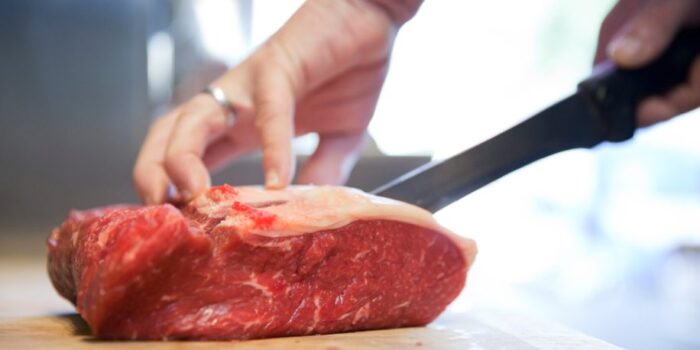
Slaughterhouses and coronavirus; once again, it turns out to be an unpleasant combination. Another outbreak of the coronavirus has been identified at what we might more politely call a meat-processing company.

This week, there was a great deal of concern about the situation in slaughterhouses, because locations of meat company Vion in Groenlo and Apeldoorn had to close. Every week, around 300,000 pigs and almost 18,000 cattle are slaughtered at Vion. There was an outbreak of the virus in Groenlo, and in Apeldoorn the police intervened because employees travelling from the surrounding area and from Germany to the slaughterhouse in minibuses were sitting too close together. Vion was subsequently reprimanded by the regional safety authority, NOS reported earlier.
Hotspot
Now it has happened again: the GGD has tested 130 of the approximately 1,700 employees at Van Rooi Meat slaughterhouse in Helmond for the coronavirus. At least 21 of them appear to be infected. Earlier this week, three other employees had also already tested positive for coronavirus. According to the Regional Safety Authority, these test results indicate that there is a risk that the company is a hotspot for the spread of coronavirus. The slaughterhouse must therefore close its doors until next Tuesday inclusive.
Safe meat?
I don’t know about you, but reports like these always make me a little nervous. I hardly eat meat myself, but I immediately find myself wondering: can we still eat the meat from these slaughterhouses?
According to the Netherlands Nutrition Centre, we can:
Er is geen bewijs dat voedsel een bron is om het #coronavirus over te dragen. Het virus heeft mens of dier nodig om in leven te blijven en te groeien. Dat kan niet in voedsel.
Meer weten? ➡️ https://t.co/hB4aPivel7 @NOS #coronacrisis— Voedingscentrum (@voedingscentrum) May 22, 2020
Slaughter animals do not appear to be susceptible to the coronavirus, Wim van der Poel, a researcher at Wageningen University & Research (WUR) specialising in foodborne viruses and viral diseases in animals, told NOS. “There are no known coronavirus infections in pigs, cows or poultry, for example. So the risk of slaughter products becoming contaminated in that way is essentially nonexistent.”
Van der Poel does point to another possibility in slaughterhouses: so-called surface contamination. “If the employee slaughtering the animals is ill—and has nevertheless come to work in violation of the RIVM rules—then they can contaminate the slaughter product. The virus can survive for a short time on a dead organism, so the meat would then be infectious for a short time.”
Low survival rate
But, Van der Poel immediately adds: “A considerable amount of time passes between the moment an animal is slaughtered and the moment the meat is eaten. Moreover, although the virus can survive briefly on a dead organism, unlike bacteria it cannot multiply there. So even if there are virus particles on the meat, they will gradually die off. The chance of survival on meat products is simply very low, also because of the time that passes before such a product reaches the shop.”
Also read:


