


Q&A with Toine the Seaweed Man
Toine Wilke, better known as ‘the Seaweed Man’, is a biochemist who graduated with a thesis on seaweed. His love for seaweed and salty sea vegetables runs deep. So deep that he wrote a cookbook about them. Meet the author of Cooking with Seaweed and Salty Vegetables.

Why do you think the Netherlands should get to know salty sea vegetables?
There are three things that make seaweed unique: it is sustainable, it is healthy and it is also incredibly delicious. My personal mission is to help people discover seaweed. To encourage the transition from eating no seaweed at all to all of us eating seaweed.
Why is that necessary?
Our food system is currently completely unsustainable. Pesticides, fresh water and land are essentially being consumed rather than used. In addition, there is too little land available to actually feed the ten billion people who will be living on Earth in 2050. So we have a huge problem. The solution is actually already here: eating seaweed. Seventy percent of the Earth’s surface is water, and we only need two percent of that water to feed all those mouths. Two percent! That’s nothing. Seaweed grows very quickly and is also incredibly nutritious and delicious, so… why wouldn’t we eat it?!
Where did you first discover seaweed?
At the end of 2009, nine years ago already, in Bali. There were no waves when I was surfing there with another surfer. So we were splashing around and snorkeling a bit when he dived down and came back up with a piece of sea lettuce. He tore it in half and gave me a piece. “Here, you have to try it, it’s delicious.” A few months later, I was teaching English in a small village where westerners almost never came. After my lessons, I would always go swimming, and I swam through a seaweed farm. After three months, a single strand of seaweed is several meters long. Amazing! You don’t have to do anything with it, just eat it. I was invited over for dinner and was served seaweed cake. To my surprise, it was really delicious.
What is your favorite sea vegetable?
It depends a little on which way the wind is blowing, how my hair looks and what the waves are like. Sometimes I think: I want nothing but an omelet with dulse, with that salty umami-bacon flavor. And sometimes I think, ‘I just want a stir-fry with samphire.’ Dulse was clearly my favorite in the past, but the more I learn about the variety among seaweed species, the more I appreciate them. There are already seventy varieties of nori alone.
We are in the same building as Fish Tales, where quite a lot happens with fish. Recently, there were two kilos of mussels left over. I am completely against food waste. So a colleague and I started thinking about what we could do with them. We ended up making mussels in white wine with dried sea lettuce. Sea lettuce is a type of seaweed we hardly ever use, but in the wild you often find sea lettuce and mussels together too. It tasted fantastic! My mouth is literally watering now.
What is your most memorable sea vegetable experience?
I lived in Ireland for a year to conduct research. Every month, during the lowest tide, we collected seaweed samples. We gathered all kinds of seaweed by the kilo and then tasted it. During one of those sampling sessions, I was walking across the reef in gale-force winds, with hail alternating with brilliant sunshine. During one of those sunny moments, I saw all those seaweeds swaying back and forth on the reef. It felt like such a primal force to me. This was still in harmony with everything happening in the sea. I found that beautiful. I almost felt one with nature at that moment. As you may have noticed, I’m very much a nature person. Apparently, there are still places in the world where things are going well. That makes me happy.
https://www.instagram.com/p/BjKgHADnMcB/?taken-by=seagreennl
Why the collaboration with Fish Tales and Sea Green?
Fish Tales provides a sustainable alternative to fish. The sea would remain as beautiful as it is now if we all ate fish from Fish Tales. In the seaweed world, there are many small businesses doing very small things on a small scale. I want to make a bigger impact. I want to reach everyone. Including Joep and Anna at Albert Heijn, and soon even Henk and Ingrid, who shop at the local supermarket in Venlo. That’s why I work with Bart and Fish Tales. He has the network, he knows how to reach people on a large scale and make a sustainable impact. Partly thanks to him, I am now also included in the Sustainable Young 100 (an initiative of Sustainable Motion).
Which cookbook should we absolutely have?
Cooking with Seaweed and Salty Vegetables, haha. Otherwise, Prannie Rhatigan’s cookbook The Irish Seaweed Kitchen. She inspires me to get the most out of seaweed. Bart’s Fish Tales, of course, too. I have learned an incredible amount from Bart, especially in the culinary field. A little acidity here, a bit of spice there. I can make something and be very satisfied with it, and then Bart can make it twice as delicious.
Where does your love of cooking come from?
Actually, it comes from my love of nature. From really wanting to—and being able to—eat what nature gives us. The thing I like most about cooking is experimenting. That produces some terrible fuck-ups, things that are truly inedible, but also things that are a lot of fun. I actually prefer cooking just for myself, so I don’t have to justify what I’ve done.
What is your biggest fuck-up so far?
I made it this week. A salad with, I think, wakame, ginger syrup and pear. My mouth is already twisting at the thought.
What would you still really like to eat someday?
Nori from the first harvest of the season in Japan. That harvest is special because of its high protein content. As the water gets warmer, the proteins are broken down through a biological process. Pepper dulse is pretty good in May, for example, but in January or February… wow. That first harvest tastes as if you’re eating ham, cheese and lobster all at once. Absolutely amazing.
A few hundred euros per kilo is paid for the first harvest in Japan. It sells out immediately. The best chefs all want it. It’s just not sustainable at all.
Where can I buy seaweed myself?
Soon, we will be selling dried seaweed at Albert Heijn. Nori, dulse, sea spaghetti and wakame. They will definitely be added to the range.
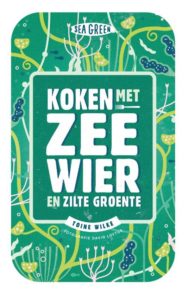
Title: Cooking with Seaweed and Salty Vegetables
Author: Toine Wilke
Publisher: Kosmos Uitgevers
Price: €17.50


