



Is champagne failed wine?
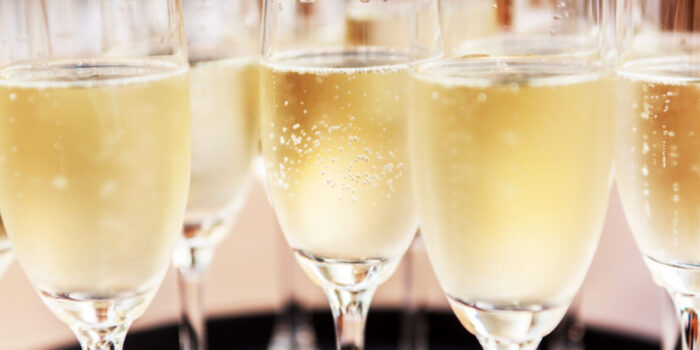
There are few things as festive and chic as a glass of bubbles, sjampoepel or—as Koen Kardashian calls it—champagneyney. But is the origin story of this sparkling wine just as festive and chic?

There are about as many theories about the discovery of the drink as there are bubbles in a glass of champagne (around a million per glass). I was once told that champagne actually originated from a failed wine harvest. Carbon dioxide was added to disguise the taste. Sounds plausible, I thought. I find the differences between champagnes much harder to taste than those between “still” wines.
Dom Pérignon
“One of the many myths and legends,” says wine expert Harold Hamersma. “Just like the story that the ‘blind’ monk Dom Pérignon was the ‘inventor’ of champagne. He wasn’t blind, and certainly wasn’t blind to success. He knew that a sparkling wine had already been made in Limoux, farther south, since 1531. After a pilgrimage to Santiago de Compostela, he took charge of the recipe and perfected it.”
British invention
“But,” Hamersma continues, “there is also talk of chauvinistic historical distortion. The technique of giving wine a second fermentation in the bottle is said to be British. English winemakers supposedly added sugar to their wines because they were too acidic. The sugar made them lively and fizzy.”
Lucky accident
That ties in somewhat with the theory that the fizz has to do with a cold climate. England is not exactly known for its tropical temperatures, after all. Neither is the Champagne region. The grapes were (and are) harvested late there. In the cold cellars, the grapes fermented slowly, and in winter the temperature could even drop so low that the yeast cells stopped working altogether. Some of the sugar was therefore not converted into alcohol and remained in the wine. The wine was bottled and, as long as it stayed cold enough, nothing happened. As soon as spring arrived and temperatures rose, the wine began to bubble: the remaining unfermented sugar was converted into carbon dioxide. In other words: bubbles and foam. Although it was seen as a mistake, people drank it anyway and eventually came to enjoy it.
So was it a case of a happy little mistake after all?
Hamersma: “We’ll never know. Champagne is more or less the wine surrounded by the most theories. A case of ‘so the story goes.’”
Ah well, it probably won’t make us drink any less of it. Cheers!
Read also:


