


How to: maintain your wok

While all you have to do with a simple saucepan is wash it, a good wok requires a little more maintenance. It’s not difficult, but you do need to know what to do. With this guide, you’re guaranteed to succeed.

If you take good care of a wok, it will last a lifetime. The more you cook in it, the more flavor develops in the pan, the stronger the non-stick coating becomes and the better your food will taste.
Buying
You might have to save for a few months for a good frying or roasting pan, but you can get a wok for as little as twenty euros. In any case, stay well away from anything with a non-stick coating and buy a steel wok. Asian grocery stores sell them in various types and sizes, or order your own online. There are also woks that are considerably more expensive, but you really don’t need to spend more than €25. All that divine Asian street food isn’t made with a Le Creuset wok either, so spend that money on something else.
Woks with a round bottom are the most common and are great if you cook on gas. Do you have an induction cooktop? Then look for a wok with a flat bottom.
Seasoning
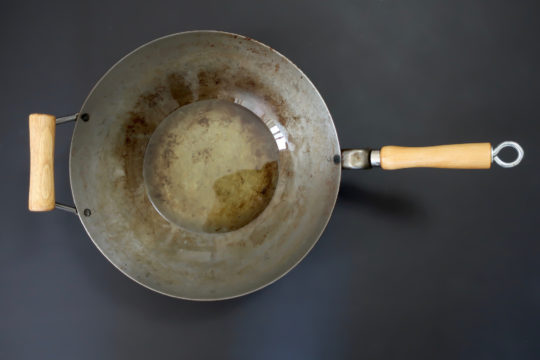
A metal wok doesn’t have a non-stick coating of its own, so you have to create one yourself. You do this by seasoning your wok. By heating the wok until very hot and allowing oil infused with spring onion and ginger to soak into the pan, you create a very thin layer that prevents food from sticking. The more you cook in your wok, the thicker this layer becomes, and therefore the better the wok gets. Over the years, the color may change from shiny silver to jet black, and that’s exactly what you want.
Metal woks are coated with factory oil to prevent them from rusting in the store; you must scrub this oil off before seasoning the pan. The best way to do this is with a steel scrubber and dish soap. Dry the wok thoroughly before you begin seasoning it. Open the windows and turn the extractor hood to its highest setting, because it will smoke, and there may still be traces of that factory oil somewhere. You obviously don’t want to breathe that in.
Chop 1 bunch of spring onions into 5 cm pieces and slice a piece of ginger about 10 cm long. Place the wok over high heat and let the pan heat up thoroughly for 30 seconds to 1 minute. Sprinkle a few drops of water into the pan; if the water evaporates immediately, the wok is hot enough. Remove the wok from the heat and pour 2 tbsp sunflower oil into the pan. Move the wok in circles so that all sides of the pan are coated with oil. If the oil starts smoking immediately, your pan is too hot, so let it cool down briefly.
Put the wok back on the heat and add the spring onions and ginger. Reduce the heat to medium and stir-fry the spring onions and ginger for 15–20 minutes. As you do this, stir everything well along the sides of the pan. Is it getting too dry? Add a little more oil. The color will slowly become slightly more yellow and brown. Turn off the heat and let the wok cool completely. Remove the spring onions and ginger and wash the wok with hot water, not dish soap. Dry the wok: place it over low heat for 1–2 minutes until there are no more water droplets in the pan.
Maintaining
Your wok is now ready to use, but it hasn’t reached its full potential yet. A well-maintained wok gets better the more you cook in it. At first, cook foods with as much fat as possible. Make stir-fries with plenty of oil, fry to your heart’s content or cook bacon in it. This strengthens the pan’s non-stick coating. Initially, avoid too much moisture and acidity. Wait a little longer before steaming and boiling, and don’t cook with ingredients such as lemon, vinegar or tomato. After a while, all of this is perfectly fine, but at first the wok mainly needs fat to form a thicker protective layer.
Washing
After cooking, rinse the wok with water and a sponge; don’t use dish soap. Usually, a thin greasy layer remains in the pan, but that’s exactly what you want. The oil soaks into the pan and helps create the non-stick coating. Don’t dry the wok with a tea towel; instead, place it over low heat for 1–2 minutes. This allows the thin layer of leftover oil to soak into the pan, which is exactly what you want.
Rust
Have small rust spots appeared on your pan? You can scrub them right out. Heat the wok over high heat as you did when seasoning it. Turn off the heat and add 1.5 tsp oil and 1 tbsp salt. Scrub with several layers of folded paper towel until all the spots are gone. If necessary, hold the paper towel with kitchen tongs to prevent burning your hands.
Also read:


