



Salami vs. cervelat
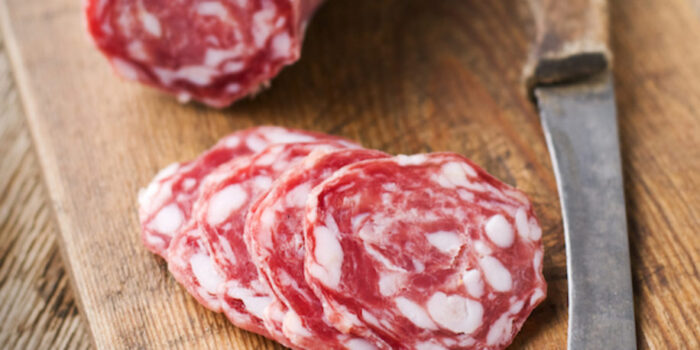
Staring at the pre-packaged slices of supermarket meat, the same question comes to mind time and again: what is the difference between salami and cervelat? We understand why: at first glance, the two sausages look remarkably alike. But ultimately, they have more differences than similarities. We’ve listed them for you.

Type of meat
Real cervelat is a variation on cervelas and is made from beef, pork and pig brains. Though those brains are certainly no longer found in modern supermarket cervelat. The sausage still owes its name to them: cervelat comes from the Italian word cervallata, which means brains. Salami contains only pork. It comes from different cuts of the pig, often the shoulder and neck, but the fattier cuts of meat are also needed for the ultimate salami.
Taste
First of all, salami contains plenty of garlic. You also season the sausage with herbs and spices (often pepper, chili pepper, fennel or parsley) and a splash of red wine. Can’t we be more specific? No, because which type of wine and flavorings are used depends on where the salami comes from. In any case: if all is well, you won’t find garlic in cervelat. Nor any other herbs, just some pepper and salt. And definitely no wine. This makes the sausage taste milder.
Shapes and sizes
When you think of salami, you probably picture those large smoked slices for your sandwich. Yet a dry, firm and wide sausage with a white casing can also be salami—please don’t confuse it with the narrow fuet. The same goes for a container of oval, paper-thin slices: it could be salami. In other words, the shape does not necessarily reveal whether something is salami. Cervelat, on the other hand, always looks more or less the same: the slices are always nice and large and perfectly round, while a whole sausage in its packaging is thick and fairly short. And there’s no white layer of mold around it.
Different varieties
Cervelat comes in different varieties. In the supermarket’s fresh meat section alone, you’ll find five different kinds. First, there’s coarse cervelat: a mild sausage with—as the name suggests—a somewhat coarser-ground meat mixture. Then there’s pepper or mantel cervelat: the sausage with a layer of pepper or Parmesan cheese on the outside. Wijncervelaat is a French sausage made from very finely ground meat with a sour taste—and no, it doesn’t contain wine. Don’t confuse it with boerenmetworst. That is a smoked (and therefore firm) sausage made from ground pork with a low fat percentage. It often simply comes from the northern Netherlands.
Salami, too, comes in infinitely many varieties. In Italy, every region has its own salami sausage. A typically Italian variety that has been downgraded to supermarket salami is spianata ‘d Romana: a sausage made from finely ground pork with coarser pieces of bacon (jowl) added. The sausage gets a slightly sweet flavor from the cayenne pepper, whole peppercorns and garlic soaked in wine, and is pressed flat during aging. Hence the oval shape of the slice. Don’t confuse this sausage with the (non-Italian) pain d’Ardenne: also a type of salami and also pressed flat, but without coarse pieces of pepper and made with slightly finer-ground pork. Further along the meat aisle: salami from Milan made with lean pork, salami from Tuscany made with red wine and fatty pork cheek, and salami from Felino with a lovely bite. Also: Hungarian salami (colored with paprika) and German salami (heavily salted and smoked). Not to forget: Serrano salami, made from—yes, really—Serrano ham.
And what about snijworst?
Because it is made from pork alone, it is best compared with salami. It also looks remarkably similar. But because it contains no garlic, it officially does not belong among the types of salami. And what about pepperoni? This spicy American pizza sausage also contains beef. So it isn’t real salami.
Also read:


