


Wasabi: the real deal
Wasabi KitKat (David Chang is a fan), wasabi balls, wasabi mayonnaise—there are so many products containing the spicy stuff, but what is actually the real deal?

To get you out of a dream straight away, 99 percent of the time you eat wasabi, it isn’t wasabi at all, but a mixture of horseradish, mustard and food coloring. These ingredients are made into a powder that is later mixed with water. This produces the thick, sticky green paste we know from sushi palaces.
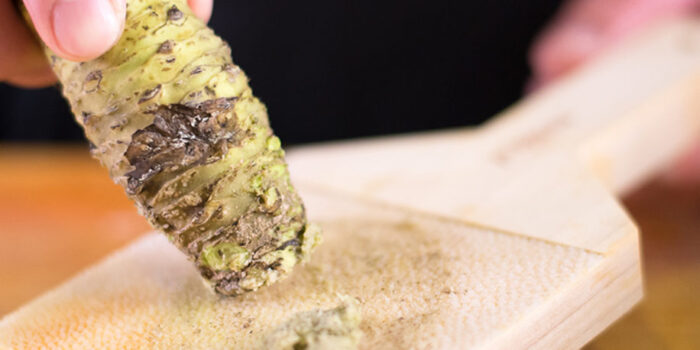
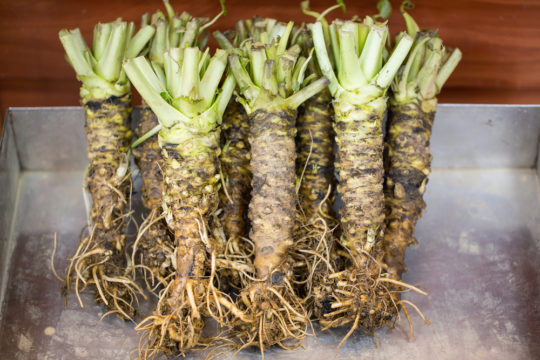
The real deal is a kind of root that looks a little like a ginger root, but greener and somewhat narrower. Mind you, it isn’t a true root, but belongs to the brassica family, which is a type of cabbage. You only use the stem of the wasabi, which is the green part.
There are stories going around that suitcases full of wasabi are being smuggled into the country illegally.
Oka or Sawa?
There are two types of wasabi, Oka and Sawa. Oka wasabi grows on the ground and tastes quite bitter. According to Leendert Bom of Wasabi4You, it even has something of a Brussels sprout flavor. Even the most untrained wasabi eater can eat a teaspoon of it without batting an eyelid. Sawa is the more expensive variety and has a slightly sharper flavor, but both are still considerably milder than horseradish.
What makes Sawa special is that it only grows when a continuous layer of clean water from nature flows past it. In Japan, there is a place in the mountains just below the snow line where wasabi can thrive, but it is quite difficult to grow wasabi in places outside Japan. You need moist soil rich in minerals, and you can find that almost nowhere outside Japan.
Western wasabi
For some time now, people in China and England have been experimenting with growing wasabi. In Dorchester, wasabi is being successfully produced at a secret water source, according to Bom. In the Netherlands, it is not feasible to grow the spicy stuff—the production costs are too high for what it yields.
A Westerner cannot taste the difference between Sawa and Oka. That is why the cheaper Oka variety often passes for Sawa. Even Japan buys Oka from China and later sells it in its own country and Europe as the expensive stuff.
Illegal trade
And what happens when there is little of something? The price goes up. A piece of wasabi is sold for 125 dollars per pound, and there are stories going around that suitcases full of wasabi are being smuggled into the country illegally. An additional problem is that much of the Japanese wasabi was contaminated with radioactive radiation after the Fukushima nuclear disaster. That is why Dutch customs officers take a week to inspect all imported products from Japan. And that week is killing for the quality of the fresh product.
Would you like to serve real wasabi without radioactive radiation with your next meal? You can buy it here. At restaurants Yamazato in the Okura and Taiko in the Conservatorium Hotel (both in Amsterdam), you can also get the real stuff with your sushi.
Read also:


