



10 bread terms every home baker should know
Coming from a family with French and Italian ties, Issa Niemeijer grew up in a tradition of home baking and an appreciation for quality and simplicity. In A Book About Bread, Issa, from the renowned artisan French bakery Gebroeders Niemeijer in Amsterdam, shares his knowledge and passionately talks about everything to do with bread. It is more than a recipe book: this is the book he himself missed when he started out as a baker.

After an introductory chapter, you are guided step by step through making your own bread, initially in your mind—you are not actually doing anything yet, but in a very accessible and intuitive way you become familiar with dough—and everything that happens in a dough. And believe me, it all sounds so mouthwateringly delicious that you can’t wait to get started yourself! These are the bread terms you really want to know:
Alveoli
The ‘air pockets’ in the crumb of the bread.
Autolyse
The resting period you can give a dough immediately after the initial mixing, before the dough is possibly properly kneaded and before salt and yeast are added.
Couche
A linen cloth on which you let the dough rest (coucher means to sleep) after shaping it. In French bakeries, linen cloths specially made for this purpose are used. The cloth is usually rolled up, placed on a large baking tray, and then unrolled little by little to place the pieces of dough (called ‘patons’ in French) on it, with a raised fold between each loaf, so that the bread is supported and does not touch the other loaves. This makes it easier for the dough pieces to retain their shape during the final proof: instead of spreading out, the dough pieces rise upwards. The couche also ensures that the dough pieces do not stick to the baking tray, so you can easily remove them later for baking.
At home, you probably do not have couches or large baking trays available, and your refrigerator is probably not as large as the proofing cabinets in a bakery. The trick is to make your own couches by taking an ordinary tea towel and placing it on a small baking tray or rectangular dish that fits in your refrigerator. L just make sure you do not place the loaves too close together on the couche. They should primarily continue rising upwards, but also spread slightly sideways.
Façonnage
Shaping the loaves; sometimes divided into prefaçonnage, the pre-shaping, and façonnage, giving the final shape.
Grigne
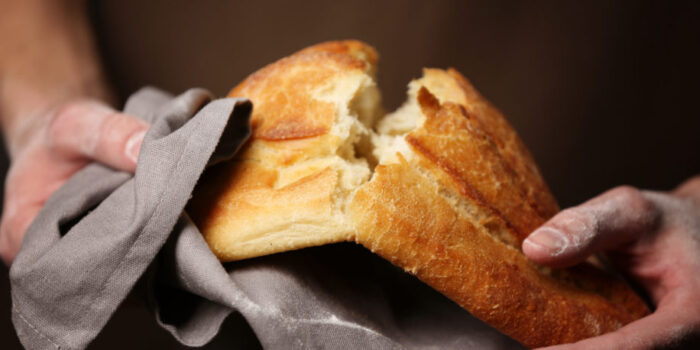
The place where the bread has split open during baking, as with a baguette. ‘La grigne’, the grin, begins with the cut that the baker makes just before baking. This allows the dough to open beautifully and uniformly, creating a sharp, raised edge. In France, it is considered the baker’s signature. When the bread is placed in the oven and reaches the stone floor, an enormous transfer of heat takes place almost immediately and the crust begins to form almost at once. This is slowed only by the steam that is also usually added at the beginning of baking, allowing the crust to remain flexible and yield for a little longer. The bread begins to increase in volume after just a few minutes, while the crust can still stretch slightly, but then the crust no longer yields and bursts open where there is the least resistance—that is, where the baker scored the bread.
To score a loaf, use a razor blade (‘lame’) that you can, for example, attach to the flat side of a small teaspoon with a narrow handle. Use only the tip of the razor blade and hold it at a slight angle. Make quick movements so that you score the bread ‘cleanly’, without the dough sticking to the blade. Do not cut too deeply either; a very light cut is sufficient. This prevents the bread from losing too much strength and collapsing where you scored it.
Gluten
The chains of proteins in a dough that can hold on to the gases in a dough.
Lame
The sharp razor blade used to score bread just before baking.
Pâte fermentée
A starter dough with the same composition (including salt and yeast) as the final dough, but which was made earlier (or saved from a previous time).
Bread peel
A tool used to place a piece of dough directly on the floor of a stone oven, or to remove a baked loaf from the oven floor. To place bread on a baking stone in your oven, you will have to transfer it from a couche, container or basket. A fully developed loaf cannot easily be picked up with your hands; and besides, it is nicer not to have to put your hands into the oven… A better way is to place the bread first on a peel, such as those also used in pizzerias.
Starter
A small dough made in advance and added later to the final dough.
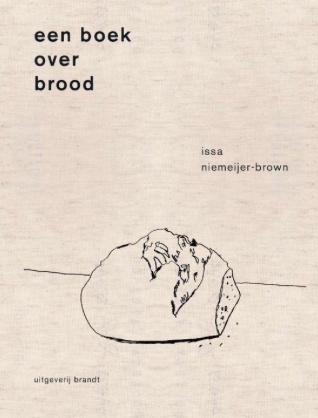
Title: A Book About Bread
Author: Issa Niemeijer-Brown
Price: €30
Publisher: Brandt Publishing
Read also:
- Recipe: 8 steps to the flatbread of your life
- Spreading on too much butter (with bread crumbs). WHY??
- Recipe: garlic knots, super-quick garlic rolls


