



About balsamic vinegar: what different types are there (and which kind is the real one?)

When we hear the term ‘black gold,’ we immediately think of coffee. The Italians don’t. They think of balsamic vinegar (although they also have fantastic coffee… Lucky bastards). Balsamic vinegar is a rich, flavorful product with a complex aging process. But the balsamic vinegar you find at an Italian delicatessen isn’t sitting on the supermarket shelf. What types of balsamic vinegar are there, and what exactly are the differences?

If there’s one thing I could eat every day, it’s Caprese salad. A simple dish in which the quality of the ingredients is hugely important to the flavor. The same goes for balsamic vinegar: an ingredient I love adding to Caprese. You can really taste the difference between top-quality balsamic vinegar and one you pick up for a few euros at the supermarket. So what’s the deal?
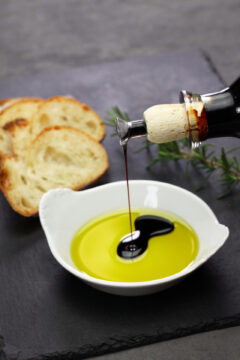
Real balsamic vinegar
Right, let’s start at the beginning. What exactly is balsamic vinegar? Balsamic vinegar originates in Modena, a region in northern Italy. It is also known as Aceto Balsamico Tradizionale di Modena. This is a protected name. Not every balsamic vinegar may be called that. The must—the freshly pressed grape juice that still contains the grape seeds and skins—must come from Modena. It may also be made from just 7 grape varieties. Sometimes wine vinegar is added to the must. But the less wine vinegar, the better the quality (ideally, none at all). And the longer the balsamic vinegar subsequently ages in wooden barrels, the better the quality becomes.
Traditional Aceto Balsamico Tradizionale is also made in Reggio Emilia (which is also in northern Italy; it is a city in the Italian region of Emilia-Romagna). In that case, it is of course not called Aceto Balsamico Tradizionale di Modena, but Aceto Balsamico Tradizionale di Reggio Emilia.
Aging like sherry
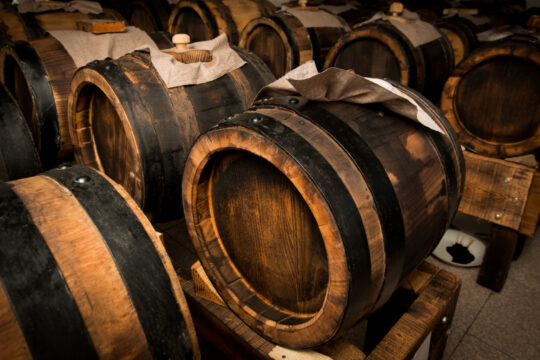
This aging process in wooden barrels follows a special system: the Solera system. This system is also used to age sherry. In short, the balsamic vinegar is stored in an increasingly smaller barrel, and each time in barrels made from different types of wood. Once a year, some of the vinegar is removed from the smallest barrel (around 10 to 15 liters) and replaced with balsamic vinegar from the second-smallest barrel. This continues all the way to the largest barrel.
Aging the best-quality balsamic vinegar takes at least 12 years, but can also take 25 years. The longer it ages, the more complex the flavor. That complexity also comes from the temperature variations to which the balsamic vinegar is exposed. The barrels aren’t stored in cellars, but in attics.
Not every ‘balsamic vinegar’ you come across has gone through such a complex process. What a dream world it would be: a bottle of balsamic vinegar that has been intensively aged for 25 years in the Modena region, for a few euros! No, for a real bottle of Aceto Balsamico Tradizionale di Modena you’ll have to dig deep. It can easily cost 150 to 400 euros. Gulp.
1. Aceto Balsamico Tradizionale di Modena DOP
The real, genuine balsamic vinegar, as the Italians would say. The balsamic vinegar we talked about at the beginning of this article. ‘DOP’ stands for Denominazione d’Origine Protetta: protected designation of origin in Italian. This is balsamic vinegar of the very highest quality. The balsamic vinegar has to meet all kinds of quality requirements; only then does it receive a DOP seal.
The grape must must come from (the area around) Modena, for example, only 7 grape varieties may be used (including Lambrusco and Trebbiano), and the balsamic vinegar must have aged for at least 12 years. It may contain only grape must and no other additions.
This balsamic vinegar always comes in bottles with a capacity of no more than 100 milliliters. Talk about black gold: with Aceto Balsamico Tradizionale di Modena DOP in your hands, that’s exactly what you have. Silky smooth, a perfect balance between sweet and sour, fruity and caramel-like… as if an angel is peeing on your tongue.
2. Aceto Balsamico di Modena IGP
This variety also has a protected name, but it is the cheaper sibling of Aceto Balsamico Tradizionale di Modena DOP. Aceto Balsamico di Modena IGP may, for example, be removed from the barrels after just 60 days of aging. That’s quite a difference from 12 or even 25 years! Aceto Balsamico di Modena IGP often also contains some wine vinegar. You won’t find that in Aceto Balsamico Tradizionale di Modena DOP .
The proportion of grape must must be at least 20%. In addition, the balsamic vinegar must be processed in Modena or Reggio Emilia, although the finished product may be bottled outside these areas. The good news is that you can actually find Aceto Balsamico di Modena IGP in supermarkets. And the price-to-quality ratio is therefore excellent.
3. Condimento
Condimento refers to balsamic vinegar that has been produced traditionally but does not meet all the quality requirements mentioned above. This makes this balsamic vinegar very reasonably priced, although the quality… That can vary quite a bit. This absolutely does not mean that Condimento is inedible. You can simply taste a clear difference compared with Aceto Balsamico Tradizionale di Modena DOP or Aceto Balsamico di Modena IGP.
This may be because the aging process of the Condimento was super short, or because the product has been heavily diluted with vinegar. Take white balsamic vinegar, for example. That isn’t real aceto balsamico. It is mainly white wine vinegar with a little grape must added.
Real Aceto Balsamico Tradizionale di Modena DOP is like having a treasure of gold in your home. You probably won’t buy it just like that, but if you get the chance to taste it… then you’re basically spoiled. Because after that, you won’t want anything else!
Also read:


