


Béarnaise or Hollandaise: what’s actually the difference?
Two cornerstones of French cuisine: Béarnaise sauce and Hollandaise sauce. Both involve egg yolks, butter and a whole lot of stirring. So what’s actually the difference between the two? How do you make them? And what do they taste best with?

In French cuisine, there are five ‘mother sauces’, a kind of basic sauces. If you can make those sauces, you can actually make all the other sauces too, because the rest are more or less derived from those basics. Hollandaise sauce is one of those basic sauces, alongside mayonnaise, béchamel, velouté, tomato sauce and Espagnole. There’s a lot of pomp and circumstance surrounding those sauces, but none of them are actually that difficult. Hollandaise, for example, is essentially a kind of warm mayonnaise. What do you eat it with? For example, asparagus, artichokes and broccoli, or a piece of salmon. And Eggs Benedict without Hollandaise sauce makes absolutely no sense; a good Hollandaise is truly essential!
How to make Hollandaise sauce
- Melt the butter over low heat; it must not change colour. Pour the melted butter into a small jug so you can pour it easily later.
- Put the egg yolks in a bowl. Quickly stir in a squeeze of lemon juice and add a pinch of salt.
- Place the bowl with the egg yolks over a pan of hot water. Keep whisking; you want the egg yolks to become light and frothy. At some point, the egg yolks will start to thicken slightly. Be careful: this is where things can go wrong—the yolks must not set!
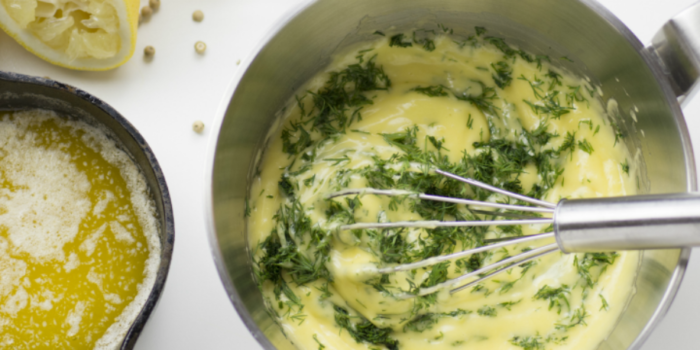
- Now pour a little melted butter into the yolks and whisk like crazy. Each time the butter has been incorporated, add a little more, until all the butter has been added. You now have a thick, creamy sauce. Season the sauce with a little more salt and, if desired, some white pepper. You need to serve the sauce immediately; you can’t keep it for long, and reheating it won’t work either.
Béarnaise is the daughter
Béarnaise sauce is therefore a daughter of Hollandaise sauce. Instead of lemon juice, you use white wine and white wine vinegar, which you reduce and flavour with fresh tarragon, fresh chervil, a finely chopped shallot and some ground pepper. A reduced vinegar with herbs is called a gastrique; if you want to impress as a home cook, you can definitely use that word. Strain the gastrique before making the sauce. When the sauce is almost ready, add a little more finely chopped chervil and tarragon.
Nothing wrong with lobster
What do you eat Béarnaise sauce with? It belongs with a classic entrecôte, with good fries. Ideally, the entrecôte should be grilled for a delicious smoky flavour. But lobster with gratinated Béarnaise sauce is something no one would turn down either.


