


Brilliant discovery: the Italian wine window (buchetta del vino)
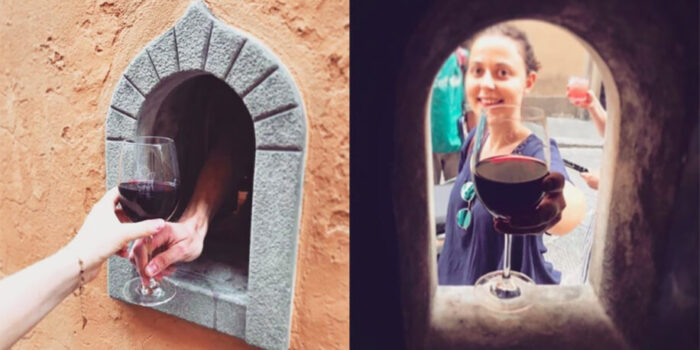
Italy has the Fiat, the Colosseum, the Vespa and the Vatican. It has Michelangelo, Andrea Bocelli and Gianluigi Buffon. And Italy has the wine window.

In everyday life, I’m a bit scatterbrained. The fact that I miss half of the things people say to me is partly due to the fact that my focus is always drawn toward silly things. On the street, though, that can lead to some pretty fun discoveries. For instance, I developed a fascination with towers and discovered the wine window.
That wine window, incidentally, is certainly not something I truly discovered. Anyone who pays a little attention while wandering through Florence is guaranteed to have come across them already. They’re at gnome height and prefer to hide beside or even on the enormous doors of palazzi. And once you’ve spotted one, you suddenly see them everywhere.
Buchetta del vino
A wine window, then, commonly known as a buchetta del vino. It has nothing to do with gnomes, but with the cellars in the palazzi, where wine was stored. During the Renaissance, a palazzo resident with a bit of status had enough money to manage a vineyard outside the city. The wine was eagerly drunk within the palace walls and sold to the common people.
In the past, the wealthy members of society weren’t particularly keen on coming into contact with the public. More than enough reason to knock a hole in the wall that was just large enough for a fiasco (a round Tuscan wine bottle covered in wicker) to fit through. It was filled in the safety of the owner’s own fortress, in the wine cellar, and then handed directly to the buyer through the little window. And the public didn’t turn up its nose at that, because everyone knew that you got better wine from the aristocracy than at the local tavern.
Laughing behind the wine window
When the Italian plague ravaged the city around 1600, the palazzo residents were certainly the last ones laughing behind their wine windows. The fortunate owners of such a buchetta learned a valuable lesson from that: during the pandemic, wine and other goods suddenly passed over the aristocratic version of the counter once again, enabling contactless delivery.
So I was delighted when, during a little internet browsing, I discovered that there is a bona fide organization that counts and protects the buchette del vino (which apparently were originally called finistrini and also appear elsewhere in Tuscany). Today, according to the Associazione Buchette del Vino, there are nearly 300 of them—a number that is still changing because the association is nowhere near finished counting. And that requires precision, because every window has to be investigated to determine whether it’s not a fake, of which there are also some in circulation. Be sure to admire the dedication of these window watchers on their website, where every window has literally been mapped and sorted from A to Z.
Read also:
- Fill the glasses again: wine tasting makes you smarter
- At this resort, you can swim in red wine
- You want this now: a wine tap for your home
Source: Italiamo


