



Buying a Coffee Machine? Expert: These Are the Mistakes You Shouldn’t Make
Want to drink coffee at home that’s just as delicious as the coffee at your favorite café? You can! More and more fantastic coffee machines are appearing on the market, allowing you to make amazing coffee yourself. What should you look out for when buying such a machine, and which mistakes should you avoid? Peter van Liempt from Sage knows.

At the most recent edition of the Amsterdam Coffee Festival, I couldn’t believe my eyes. The coffee world is booming! And since drinking coffee out of the house is becoming increasingly expensive, I’d love to be able to make top-notch coffee at home. Third wave coffee, to use the correct terminology. But there are so many different coffee machines for sale—how do you know which one suits your needs and what should you look out for when buying a coffee machine? I attended a mini workshop at the Sage stand.
Third wave coffee
Over the years, the coffee industry has gone through three major ‘waves’. It’s almost impossible to imagine now, but around twenty-five years ago, Coffee Company, in Starbucks’ slipstream, was more or less the height of sophistication if you wanted to drink a good coffee out of the house. But in the meantime, so-called ‘third wave coffee’ has been sweeping across our country for a while now.
That third wave refers to the coffee evolution we are currently experiencing. The first wave began around the start of the twentieth century, when coffee became widely available and coffee consumption increased worldwide. Coffee became cheaper and more accessible through innovations such as instant coffee and vacuum packaging. During the second wave, more attention was paid to the taste of coffee. Coffee quality improved by leaps and bounds and coffee shops emerged. Chains such as Starbucks took off.
With third wave coffee, we are increasingly looking for personal ‘single origins’ (coffee from one type of bean), wanting to know how and where coffee beans are produced, how long the beans have been roasted and exactly how the coffee is prepared. All to experience the best possible flavor. How do you do that at home with your own machine? Peter knows.
What should you look out for when buying a coffee machine?
Peter: If you want to experience ‘third wave specialty coffee’ at home, you need a machine that can meet a number of important requirements. At Sage, we have developed a ‘4-step formula’ for this. These are also the four standards our professional machines meet.
- An ideal dose of 18–22 grams of freshly ground beans in your portafilter
- Optimal (extraction) pressure of 9 bar
- Precise water temperature of 93 degrees ˚C
- Powerful steam pressure at 130 degrees ˚C, allowing you to make silky-smooth microfoam.
Oh, extraction—how exactly does that work?
The perfect espresso extraction is achieved through a combination of three factors: dose, grind size and extraction time. With under-extraction, the taste is often sour, while over-extraction produces a bitter taste. Both flavors are then excessively pronounced. If you want to achieve the perfect balance, it’s advisable to ask for advice at a specialty coffee shop (for example, at one of these fantastic coffee shops in Amsterdam and Rotterdam).
What are the most common coffee mistakes, and how can you avoid them?
It all starts with good coffee beans. The difference in taste (sweet, salty, sour and bitter) between coffee beans is immense, which is why they are often compared to wine, and nowadays to specialty beer as well. Connoisseurs can perceive an enormous flavor palette in different coffee beans. If you want to get the most flavor out of a coffee bean, you need an espresso machine.
Freshly roasted beans vs. supermarket beans
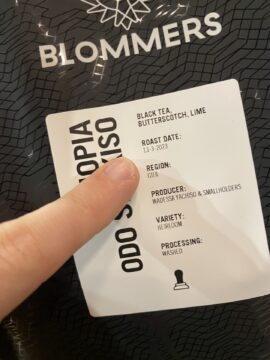
When making specialty coffee, freshly roasted beans are always used. You can recognize them by the label on the bag of beans, which states the roasting date (e.g. 15-03-2023). Freshly roasted beans can be bought from specialty coffee shops and micro-roasteries. A bag of quality coffee beans contains information about the variety, the country where the coffee was grown, the region it comes from, the processing method used and, of course, the roasting date. Most supermarkets sell beans with a best-before date (e.g. 31-6-2025). This is a major difference.
Freshly roasted beans are roasted much more lightly, allowing (delicate) aromas—such as body, mouthfeel, finish and viscosity—to come through better. Supermarket beans are roasted much darker and for longer, causing most of the flavors to disappear and leaving only the bitter taste.
Even more differences
The difference between freshly roasted beans and supermarket beans is not just in the roasting. Specialty coffee is generally single origin and hand-picked, while supermarket beans are a blend (mix) of beans picked by machine. Finally, the variety and the drying method also have an enormous influence on the final flavor. The great thing about quality coffee is that you can experiment with different beans from all over the world to find out what you like best. There is much more available than the familiar Robusta (more caffeine) and Arabica (a more complex flavor)!
The most important thing when buying coffee beans for home is that they are fresh. Ideally, use the beans within 30 days of roasting.
Storing beans
Good coffee beans come with a price tag. Freshly roasted beans can quickly cost 30 euros per kilo. So it’s a real shame if you don’t store them properly—much of the flavor will be lost. Store your beans somewhere dry, dark and airtight. This will allow you to enjoy their optimal flavor for much longer.
Descaling your coffee machine
It’s smart to descale your machine every three months and install a new water filter every three months (unless you use filtered water). This prevents the pipes from becoming clogged by limescale. This will extend the life of your valuable espresso machine.
Cleaning your coffee machine
There are two important reasons to keep your appliance properly clean. The first reason is simple: coffee made in a clean appliance tastes better. The second is that your espresso machine will last longer if you clean and maintain it regularly. Real baristas rinse the brewing group after every extraction. In my opinion, once a day is sufficient. What you must do is clean the milk frothing wand with a damp cloth immediately after use and flush it through; milk contains a lot of proteins. When these cool down, they stick immediately and the steam wand becomes blocked. The cause of a blocked or malfunctioning steam wand is often failure to clean it properly or in time. Prevention is therefore better than cure.
Coffee workshop
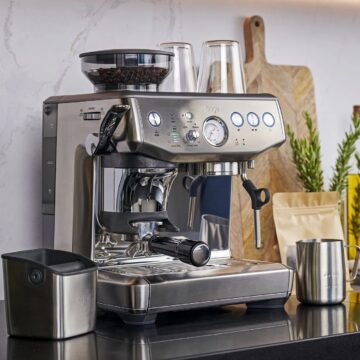
If you’ve bought a coffee machine, it’s always a good idea to invest in a workshop. Under the guidance of a professional, you’ll be taught the basic principles within 2 to 3 hours. This prevents a lot of frustration and allows you to start enjoying your espresso machine relatively quickly. And, well… I’ve made up my mind and am going to buy the Barista Express Impress. Isn’t it a beauty?
Read also:


