


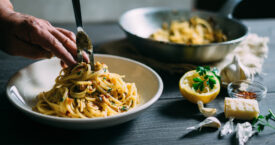
Uproar in the culinary world: carbonara is… American?!
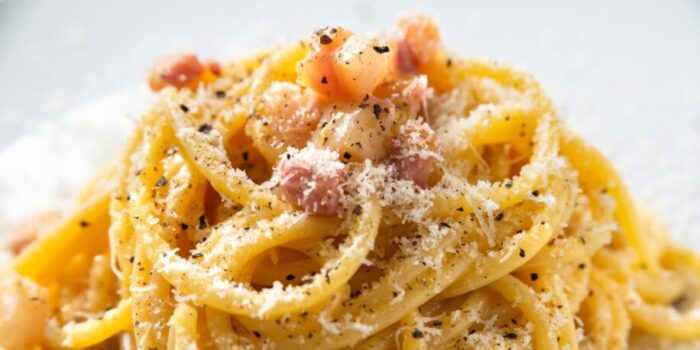
Carbonara is without a doubt one of our favorite Italian dishes. But wait a minute: pasta alla carbonara isn’t an Italian dish at all. No, according to Italian academic Alberto Grandi, of all people, carbonara is American. And to make matters even worse—‘Don’t mess with our culinary heritage!’ say all Italians—he is also dragging Italian panettone and Parmigiano through the mud. Colleague Sophie from Italiamo delved into this thorny issue. Read on and tremble.

Italian classics
The Italians are angry. Very angry. Because if you touch their culinary heritage, you’ll have them to contend with. And that’s exactly what Italian academic Alberto Grandi has done with a series of fairly controversial claims about Italian classics. Just now that the Italian government has put its sacred cuisine forward as a candidate for the UNESCO list.
Born in Italy—that much is true
He really dared to say it. Alberto Grandi has declared that pasta alla carbonara is American. Of course, the academic isn’t stupid, and I too secretly knew the theory about Americans and carbonara, because it has been documented in books for some time. Food historian Luca Cesari put it a little more subtly in his A Brief History of Pasta: carbonara is an American dish that was born in Italy, although even that wording is open to debate.
Guanciale in carbonara
In any case, more experts agree that Italian chef Renato Gualandi made the dish for the first time for American soldiers in ’44 in Riccione, using ingredients supplied by the Americans. This completely rejects the theory that the dish originated with charcoal burners around Rome (and is therefore Roman), as well as the idea that guanciale is the only true type of bacon that belongs in carbonara.
Parmesan cheese in Wisconsin
According to Grandi, Parmesan cheese is about a thousand years old, but production methods changed somewhat around the 1960s. Before then, the cheese wheels were smaller and the cheese was softer and fattier. His explanation for why you can now find real Parmesan cheese only in Wisconsin is that Italian immigrants left the Po Valley around Parma for the United States, where they continued making cheese. And while the recipe in Parma evolved over the years, the Italian immigrants stayed true to the original. My verdict? The man is probably right, but every recipe evolves over time (usually for the better), and letting the land of plastic cheeses take the credit breaks my heart for the Italians.
Pizzerias too?
I’m not going to stick my neck out here; I’ll simply tell you the facts as Grandi presents them to the world: ‘Before the Second World War, you could only find pizza in a few southern towns, and the first restaurant serving only pizza opened in New York in 1911.’ Another quote: ‘For my father, pizza in 1970 was just as exotic as sushi is to us now.’ How unromantic.
Panettone from the factory
Finally, here’s one I actually like. Today’s Christmas bread, panettone, isn’t a classic that has been made in Lombardy for centuries, but an industrial invention from the 1920s. The original panettone was a thin, hard flatbread filled with a handful of raisins, eaten only by the poor, and had nothing to do with Christmas. When bakers faced competition from supermarkets in the 1970s, they fought back with a homemade version of the factory products, and only then did the artisanal panettone we know today come into existence.
Horse’s head in your bed
Yes, and anyone who makes statements like that isn’t exactly safe. The debate has flared up because Grandi recently spoke to the foreign press for the first time for this article in The Financial Times, but he has been drawing the ire of his fellow countrymen for some time. In 2018, he was already attacked live on television by a Roman presenter because of his claims about carbonara, and there are more furious food fanatics who have spoken out against him.
Grandi himself seems largely unfazed. On his podcast, he jokes that he can no longer leave the house without security, and he doesn’t understand the commotion. ‘I’m not questioning the quality of Italian food or products; I’m reconstructing the history of these dishes in a historically and philologically accurate manner,’ Grandi said in his defense.
Also read:


