



David Chang’s Theory

By now, everyone knows that everything David Chang touches turns to gold – or at least into rave reviews and outright Instagram hits. But how does he do it? Chang himself has a theory about that: the Unified Theory of Deliciousness.

Is this dish good enough to come here and queue up for it? That is the question David Chang asks himself with every new dish. By now, the American chef has quite a few hits to his name. Think of the Momofuku Pork Buns or his ceci e pepe: his version of the Italian pasta dish cacio e pepe with fermented chickpeas.
No flukes
There are so many by now that Chang is beginning to recognize patterns. His most successful dishes are no flukes. The dishes are connected by a set of underlying laws: the Unified Theory of Deliciousness. In an article that appeared both online and in an issue of Wired, Chang explains exactly what he means by this.
Memory lane
First of all, according to Chang, you hit that sweet spot when you make something that reminds guests of another moment in their lives. Something personal, such as the specific flavor of your mother’s roast chicken or the cacio e pepe you and your loved one ate together in Rome. Such patterns are called isomorphisms: concepts that can take shape in different ways, while the structure of the concept basically remains the same.
Basic components
You can achieve this effect by making something people already know well. Though according to Chang, that is not what it is about. A dish is only amazing – and not merely good – when you achieve this with a completely new dish, while holding on to the basic components of a dish people already know.
“Ceci e pepe tells guests what to think instead of allowing them to let their own imagination run wild”
Element of surprise
For example, Chang’s cecio e pepe contains no pecorino – an essential ingredient for the flavor experience of this pasta – but chickpea hozon: a name Chang came up with himself for fermented chickpeas. It has the umami flavor of miso and a sweetness reminiscent of pecorino. That gave Chang the idea to create a new version of cacio e pepe. Though he does say he regrets the name. “If I could do it over, I would give the dish a different name. Ceci e pepe tells guests what to think instead of allowing them to let their own imagination run wild. That element of surprise is precisely part of the magic.”
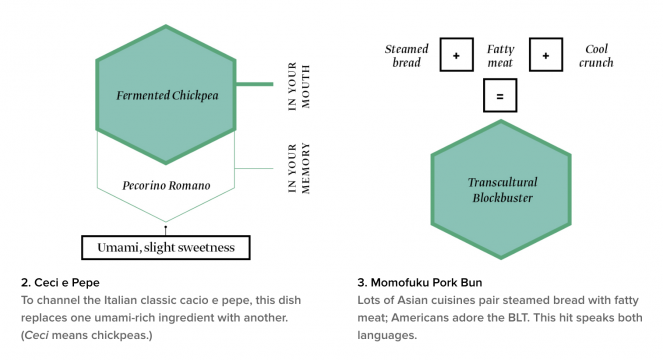
The famous Momofuku Pork Bun is also based on this principle (source: Wired.com)
Curious about Chang’s other underlying laws of success? Then read the beautifully designed and written long read on Wired.com. Highly recommended.
Text: Renée Conradi
Image: Joe Pugliese, Wired


