


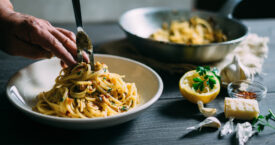
Foodlingo: Cacio e Pepe
Food editor at large Marjan Ippel regularly introduces a new or recently re-entered term from the food scene here, the so-called foodlingo. No foodie can do without it. After all, ‘what (not) to speak’ is at least as important in food as ‘what (not) to eat’.

This time: cacio e pepe
Rome, two years ago: A search through alleys and vicoli, until I arrive at the little square where, according to Anthony Bourdain, the best cacio e pepe (old Roman for cheese and pepper) in Rome is served without any reservation. I’ve been thinking for weeks that I have to try it.
Mac and Cheese
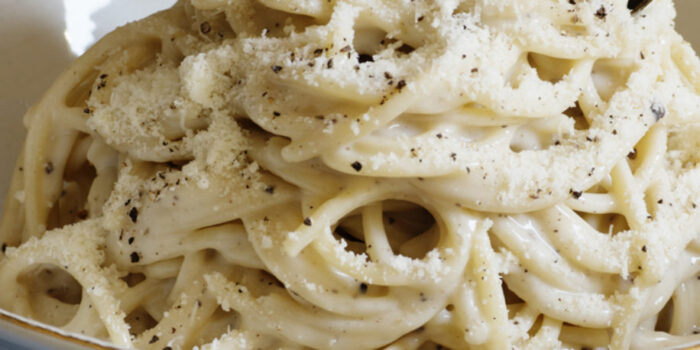
Spaghetti with aged Pecorino Romano and an excessive amount of freshly ground black pepper. No butter, no panna (cream), no oil, nothing. Pure and simple—the Roman kitchen is not called cucina povera (poor cuisine) for nothing, and alongside this legendary ‘mac and cheese for adults’ it also gave rise to the equally simple pasta carbonara.
Irresistible. Especially when the restaurant is open. Which, unfortunately, was not the case with Anthony’s tip. For that reason, I have never eaten ‘the one and only authentic’ cacio e pepe. Others, yes, but not this one, served on the Roman terrace at Piazza Santa Cecilia in an edible bowl made of… Parmigiano Reggiano.
Not because I was standing in front of closed doors, but whatever Roman cookbook or menu I open, whichever chef I ask, and however delicious it sounds to me (Delicious? Amazing!): cacio e pepe is not served in a bowl made of Parmigiano from Emilia-Romagna.
Bowl
In the thirteenth-century cookbook Liber de Coquina, a certain recipe does mention tossing Parmesan through strips of pasta, but that’s not a bowl. And it isn’t cacio e pepe either, by the way.
The Roman kitchen is not called cucina povera (poor cuisine) for nothing
And I am even more convinced of that since I learned that for centuries the dish was a winter meal that the shepherd prepared à la minute in the mountain pastures of Lazio, using strips of dried pasta, a piece of Pecorino Romano and loads of black pepper, all easy to carry in his saddlebag, to keep him warm. Because did the good man really take the trouble, right there among the sheep, to cobble together an artistic bowl from the cheese (whichever one)?
Ramen noodles
But the person who takes the most creative liberties with authenticity, ever, is of course David ‘there he is again!’ Chang. In the Netflix series Mind of a chef, also endorsed by Anthony Bourdain, the Korean-American noodle chef easily outdoes the Parmesan bowl by making his cacio e pepe with Japanese instant ramen noodles. And I absolutely have to try that too.
Want to get started yourself? We have Katie Parla’s perfect recipe for you.
Text: Marjan Ippel
Image: From: Katie Parla and Kristina Gill, Tasting Rome: Fresh Flavors and Forgotten Recipes from an Ancient City


