



Do you lose weight faster by eating tough food because you have to chew for a long time?
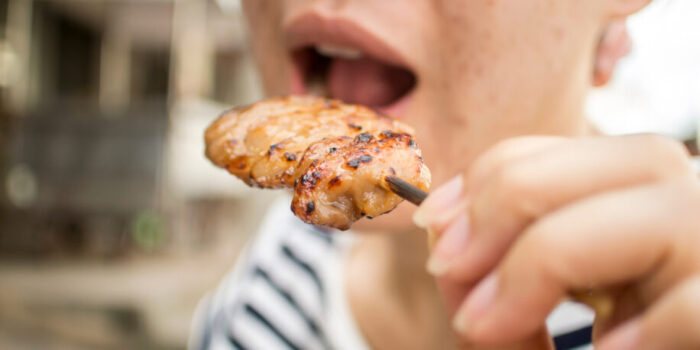
At the beginning of a new year, when the cravings for croquette letters, oliebollen, cheese boards and champagne cocktails have temporarily faded into the background, weight-loss tips may come flying at you from all directions. You may also have heard the idea that chewing your food well and for a long time helps you lose weight. But has this been proven?

For example, put a fried chicken sandwich from Naskip in my hands, and there’s no way I’ll have the patience to chew every bite forty times, as some lifestyle sites recommend. Not that you gulp down that chicken like a smoothie, for example, but I was curious about what science had to say about it: could food that takes longer to chew help with weight loss?
Chicken from the blender for science
A study in England conducted by the University of Leeds found that in more than half of the cases examined, the texture of the food did indeed affect how quickly people felt full, and therefore how much less they ate. Put simply: the people who ate an apple in slices (by the way, here’s how to recognize a delicious crisp apple) felt satiated sooner than those who ate an apple puréed into applesauce.
What I found interesting was that the fiber content didn’t have an impact, because the applesauce contained exactly as much fiber as the ‘solid’ apple. A test was also carried out with steamed ‘solid’ chicken breast alongside steamed chicken breast from the blender (yuck). The researchers concluded that “the results showed that solid food forms reduced feelings of hunger significantly more than liquid forms, and that tough foods make you feel full sooner than tender foods.” (Erm, but surely we’d rather have tender chicken breast than tough chicken…) As serious researchers, they do stress that more research is needed before any firm conclusions can be drawn about losing weight and maintaining a healthy weight in the long term.
Still, Dr. Keri McCrickerd of the Singapore Institute for Clinical Sciences, who conducted her own research into this, also confirms that the longer food stays in the mouth, where it is chewed and mixed with saliva before being swallowed, the greater the feeling of satiety may be.
Entirely to my own advantage, I’ve decided that I’m doing reasonably well with that chicken sandwich. Sure, the bun is fluffy and soft, but that chicken definitely has some bite! And I’ll try not to gobble it down, promise…
Also read:
- The best news of 2020: cheese and red wine keep you smart
- Science proves it: cheese is highly addictive
- 6 healthy food hacks: deliciously easy, so you’re still doing well
Source: BBC


