


Everything about one of the world’s most expensive spices: vanilla
Anyone who walks through the supermarket can fill their entire cart with products containing vanilla. Or at least the flavour of vanilla. So what’s the story behind this spice, which is one of the most expensive in the world? And can we lump all vanilla flavourings, extracts and pods together? A deep dive into the precious world of vanilla.

Vanilla has an accessible, sweet flavour. That’s why so many bakers and food producers love this spice. Yet, as you of course already knew, far from every product with ‘vanilla’ on the packaging actually contains real vanilla. No, real vanilla is expensive. And that has everything to do with the production process behind the spice.
Growing vanilla
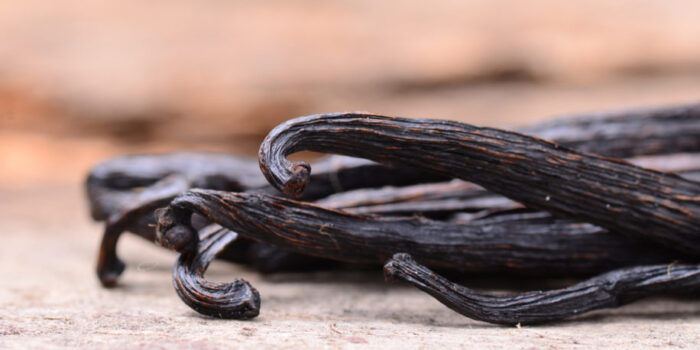
When we think of real vanilla, we picture a vanilla pod. You know, that shrivelled, brown pod that looks a little like a burnt green bean. The vanilla is inside that pod. But did you know that the pod is originally green? That makes it look even more like a green bean. Vanilla pods are the fruit of a climbing orchid species called Vanilla planifolia. Farmers pick the vanilla pods while they are still bright green. They are then fermented, giving them their characteristic brown and shrivelled appearance.
Everything involved in pollinating and processing the vanilla pod takes a lot of time. Pollinating the vanilla plant alone is done by hand, which creates a great deal of work for farmers. Many farmers spend most of the year managing one hectare of vanilla plants. On top of that, more and more harvests have failed in recent years. The reason: extreme drought. And that, in turn, is caused by… Yep, climate change.
Vanilla from Madagascar, Tahiti and Mexico
Most vanilla is produced in Madagascar. That’s where Bourbon vanilla comes from: the highest-quality vanilla you can get. The name Bourbon vanilla comes from Bourbon Island, where the vanilla originated. Today, this island is called Réunion. Other important vanilla producers include Tahiti and Mexico. Can you taste the difference between vanilla from Madagascar, Tahiti and Mexico? Absolutely. Vanilla from Madagascar tastes spicy and creamy, while vanilla from Tahiti has more chocolate and caramel notes. Vanilla from Mexico, on the other hand, has a slightly smoky flavour, along with aromas including cinnamon and sesame.
Vanilla pod
So, there is vanilla inside the vanilla pod. You need to scrape it out with a small, sharp knife. First, cut the pod open lengthwise, then scrape as much vanilla as possible from the inside. If you use these seeds in your baking, you’ll see those familiar vanilla specks. Delicious! By the way, never throw the vanilla pod away, even after all the seeds have been scraped out. You can use the pod perfectly well to make vanilla sugar or vanilla extract.
Vanilla extract
Vanilla extract is a concentrated liquid containing real vanilla. It’s a natural product in a jar. Many bakers consider it one of their favourite vanilla products because it has such a strong vanilla flavour. You can easily measure the extract with a teaspoon. Vanilla extract is often not available in supermarkets; you have to visit a speciality shop for it. That alone often says something about the product’s expense and quality. You can also make vanilla extract yourself by leaving a vanilla pod to infuse in a sealed bottle of vodka.
Vanilla flavouring
Although the name suggests otherwise, vanilla flavouring (also known as vanilla essence) contains no real vanilla. Instead, vanillin is used: an artificial flavouring that comes close to vanilla in taste. The advantage is that vanilla flavouring is cheaper than vanilla extract. But the disadvantage is that it doesn’t taste like real vanilla. And if you’re a little particular about your baking, you won’t settle for that.
Vanilla paste
Like vanilla extract, vanilla paste is made from real vanilla. The difference is that paste is thicker than extract. If you add this stuff to your dish, you’ll see those characteristic vanilla specks, just as with vanilla seeds. Vanilla paste is recommended if you find scraping a vanilla pod too much work. You can buy it in smaller and larger jars. You won’t find it at Albert Heijn or Lidl; for that, you’ll need to visit better cookery and speciality shops.
Vanilla sugar
Do you ever buy vanilla sugar at the supermarket? The chances that it contains real vanilla are small. As with vanilla flavouring, packets of vanilla sugar often contain vanillin. Of course, it’s easy and cheap to keep such packets at home, but it really takes no effort at all to make vanilla sugar yourself. Simply put one (or several) vanilla pods in a large jar of sugar and you’re done. Once the pods have infused for a while, your entire jar of sugar will taste of vanilla.
Can you substitute everything for everything else?
Sometimes a recipe calls for vanilla extract when you don’t have any at home. But what if you do have vanilla flavouring in the cupboard? Can you substitute one for the other? Yes, but you need to take the strength of the product into account. Vanilla paste, for example, is much more concentrated than vanilla flavouring. So you only need a small amount of it to achieve the same strength.
Even though it may be a little more expensive (a large jar of vanilla paste can easily cost €30), buying vanilla paste, extract or pods is absolutely worth it. Nothing beats the taste of real vanilla. Once you taste the difference between that and vanilla flavouring, you won’t want anything else!
Also read:
- The ultimate guilty pleasure: vanilla ice cream with red Fernandes
- These bananas are blue and taste like vanilla ice cream
- Recipe: mini apple pies with vanilla
Sources: Rutger Bakt, Eefsfood, Laura’s Bakery, Miljuschka


