


Foodlingo: Riftkoekje
Regularly, food editor at large Marjan Ippel introduces a new or recently re-entered term in the food scene here, the so-called foodlingo. No foodie can do without it. After all, ‘what (not) to speak’ is at least as important in food as ‘what (not) to eat’.

This time: Riftkoekje.
The potato is hot. Fried, baked, in gnocchi form or as a cookie; and from haute cuisine to street food. But although we are a nation of cookie and potato eaters, the combination of potato + cookie seemed to us to be a step too far. The Germans have their Reibekuchen, the Swiss their rösti and the French their crêpe de pommes de terre. And us?
As part of the ‘Dutch Cuisine’ movement, founded together with Luc ‘Bolenius’ Kusters to put Dutch cuisine and food culture on the map, chef Albert Kooy searched for specifically Dutch culinary heritage. Was he driven to find the polder version of Reibekuchen? Who knows.
Rifting
The fact is that Kooy’s German mentor Wulf Engel served a signature dish at De Hoefslag in Bosch en Duin centred around a crispy Reibekuchen, which, in the Francophile eighties, was nevertheless put on the pass naturellement as crêpe de pommes de terre.
How delighted was Kooy when he discovered that our country does indeed have a tradition of potato pancakes. Mainly in the provinces of Limburg and Gelderland bordering Germany, where they are served under the name riftkoekje. In which case riften undoubtedly refers, just like reiben, to the essential action: grating the potato.
The Dutch potato pancake tradition turns out to date back centuries.
The Dutch potato pancake tradition even dates back centuries, as evidenced by a mention in the cookbook De Volmaakte Geldersche Keuken-Meyd from 1761.
Dutch Cuisine
During last week’s Horecava, the steadily growing ‘Dutch Cuisine’ welcomed eighteen new members. Among them were Jim de Jong of restaurant De Jong in Rotterdam, plus Jonnie and Thérèse Boer of De Librije in Zwolle.
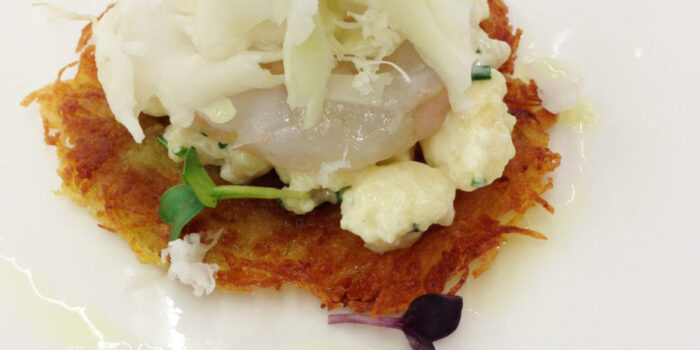
And on that occasion, Kooy proudly served his riftkoekje with three textures of cauliflower and langoustines. In terms of crispness, that cookie was clearly indebted to the German version, with the French name of his great mentor Wulf Engel. “And so you see that a national border is not always literally a divide between cultures,” said the ‘Dutch Cuisine’ chef. Fine, but let’s start with our own riftkoekje!
Check Albert ‘Dutch Cuisine’ Kooy’s foolproof recipe here.
Text: Marjan Ippel
Image: Marjan Ippel


