


Foodlingo: Tahdig
Food editor at large Marjan Ippel regularly introduces a new or recently reintroduced term from the food scene here, the so-called foodlingo. No foodie can do without it. After all, ‘what (not) to speak’ is at least as important in food as ‘what (not) to eat’.

This time: Tahdig
A meal without a crust is like a restaurant without food. High, low and slow chefs recognise the importance of a little crunch in their dish. Salpicon may be the core business of a croquette, but without a crispy breadcrumb crust we would never have bitten into them so greedily. And what is cheese fondue without the baked-on layer at the bottom of the fondue pot? A reheated mash minus the crust? Or rice without a golden-brown fried bottom layer?
The latter is regularly spotted under the name ‘tahdig’ on trendy menus, where Middle Eastern elements have by now become indispensable.
Controlled burning
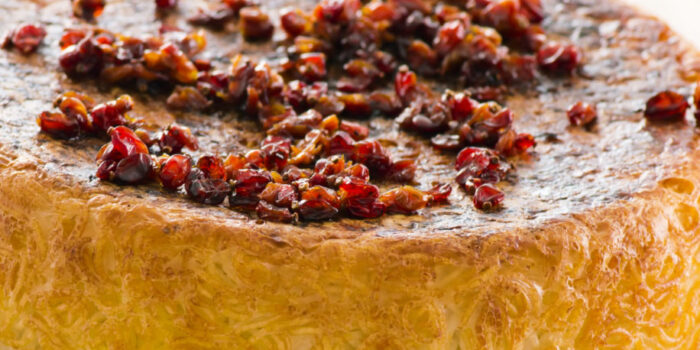
Tahdig (pronounced: teddik) is Persian for ‘bottom of the pan’. This speciality from Persian and Mesopotamian cuisine is a deliberately scorched layer at the bottom of the rice pot. Traditionally, the crispy rice layer, with its nutty flavour from browning, is served to guests as a delicacy. Often with the addition of yoghurt, saffron, tomato and, for example, potato or bread.
Slices of carrot or potato are also sometimes placed at the bottom of the rice pot, forming a crispy crust around the rice. At the same time, these often artfully cut vegetables lend an elegant pattern to the dish, which appears upside down on the table like a tarte tatin.
Worldwide, fried rice is considered a delicacy. And rightly so.
There is hardly a dish for which no variations exist all over the globe. The same goes for tahdig, which most likely originated from the universally held idea that none of the available food should go to waste. Not even a burnt crust.
Delicacy
Deep into Asia, fried rice is considered a delicacy. And rightly so. From Iraqi hkaka, which is somewhat more puffed and is also served in pieces rather than whole, to Caribbean cucayo, Korean nurungji, Vietnamese cơm cháy and Chinese mi guoba. Even Indonesian nasi goreng, Japanese yaki-onigiri (a rice ball made from fried rice) and the rice burger can be regarded as variations on the same fried principle.
For the best crust, a long-grain rice resembling basmati in flavour and texture is used. But since the arrival of the electric rice cooker has made it considerably more difficult to develop a crust on the bottom of the pot, rice is also sometimes fried in oil until golden brown and crispy specifically for this purpose, and served with, for example, dried shrimp or pulled pork and chilli paste.
David Chang
David wouldn’t be Chang if, as the creator of the compost cookie, he hadn’t also creatively embraced leftover rice. In his newest New York Momofuku branch, Nishi, he approaches Italian cuisine through Korean and other Asian cooking styles. And according to his Instagram account, he is also experimenting with baked-on rice there. ‘Hard to beat,’ reads the caption on Chang’s photo. And judging by the number of responses, many agree with him.
For those who, like many New Yorkers, don’t have a kitchen: buying it ready-made in convenient takeaway packs is also possible in some countries. And for those who do have a kitchen but aren’t kitchen whizzes: put too little water in the rice cooker and meanwhile Instagram. It can’t (go) wrong!
Text:


