


Happy (Easter) Eggs
Eggs are the symbol of fertility. So why do we eat them at Easter? Not for religious reasons, but as a sign of the beginning of spring. Try something different with your Easter breakfast egg instead of boiling, dyeing or stuffing it. Seven FavorFlav favorites.

Eggs Benedict (or Florentine)
This American favorite of the all-day breakfast scene ideally consists of two toasted English muffin halves (so, not cake!) each topped with a slice of smoked bacon or cooked ham, a poached egg and a dollop of hollandaise sauce. Vegetarians can go ‘Florentine’ and replace the meat with blanched spinach.
Huevos rancheros
Another brunch hit: a Mexican farmer’s breakfast of fried eggs, tomato-chili sauce, brown beans, avocado and rice. Served without a trace of meat on a corn tortilla. You can eat it here in Amsterdam.
Oeuf Cocotte
Eggs with the yolk left whole, baked in a cocotte (shallow oven dish) with cream, butter and anything else that goes well with it/you have on hand. From bacon to salmon. Or once again à la Florentine: spinach.
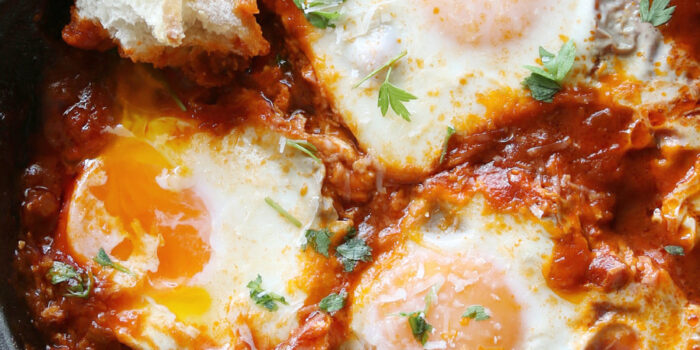
Shakshuka means something like ‘stew’ in Arabic.
Oeufs en Meurette
Whole eggs poached in a meurette or bourguignon sauce made with, among other things, red wine, butter and shallots. This gives the eggs a wine-red color.
Toad in the Hole/Egg in the Basket
An egg with the yolk left whole, fried in a slice of bread in a frying pan, with a circle (or heart) cut out of it.
Croque Madame
A dressed-up grilled cheese sandwich. While monsieur contains only ham inside and grated, gratinated cheese—or even better: béchamel sauce—on top, madame gets a fried egg on the béchamel/cheese as a bonus.
Check out the recipe for our croque in the hole here
Shakshuka
It means something like ‘stew’ in Arabic. And that’s what shakshuka also looks like when it appears on the table simmering in a cast-iron pan with chunks of bread alongside it. Usually, only the eggs are recognizable. The tomatoes, onions, chili peppers and cumin have broken down during cooking into a red, bubbling mixture.
Text: Marjan Ippel


