


How to become a charcuterie pro
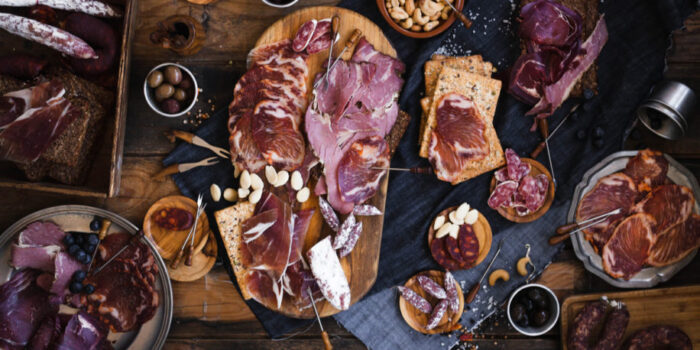
Can a piece of meat be ‘in season’? What shouldn’t be missing from your grazing board? And how much of everything do you need? In short: how do you become a charcuterie pro?

Meneer Wateetons has already written books about sausage, drinks, smoking and fermentation, and in May he is adding the book About charcuterie to the list. The perfect person to ask for some tips.
Tip 1: Make it yourself
“I’d rather make my own sausages and hams than buy them. It’s great fun to do and not nearly as difficult as you might think. Curing a ham is a matter of brining and waiting. You do need a few months, though, so if you want a board full of meat next week, you’ll have to go to the shop. On Amsterdam’s Haarlemmerstraat and Haarlemmerdijk, you can buy authentic Spanish, Portuguese and Italian delicacies within a five-minute walk of one another.”
Tip 2: Ask questions
“Make sure you get good advice from the person you buy the meat from. A nine-month-old Serrano ham looks the same to us as a three-year-old Iberico ham, but the taste is very different. So ask where the pig comes from, how long the meat has matured and make sure you get good advice.”
“Can meat be in season? Not really. In the past, pigs were invariably slaughtered in October, but nowadays it happens all year round. Besides, dried hams and sausages can of course be kept indefinitely.”
Tip 3: Fat
“The fattier, the better. You don’t eat charcuterie because it will make you slim or because you care about the health of your coronary arteries. Dutch pigs are bred and fattened so that they spend as little time as possible carrying fat. You need that fat for great flavour and juiciness. During drying, the meat loses a third of its moisture. If there’s no fat in it, it becomes a dry, tough mess. It’s better to eat mindfully: if you have a really good, fatty, flavoursome ham, two slices are enough. It won’t make you fat.”
Tip 4: Order and accompaniments
“Just as with cheese, I’d start with the mildest flavours and work towards the stronger ones. Turkish or Balkan charcuterie often contains a lot of spices, so I wouldn’t start with that. The same goes for some Spanish cured meats, which can contain a fair amount of paprika. Chorizo, for example: if you eat that and then move on to lardo (salt-cured back fat), which has a very mild flavour, you won’t taste anything anymore. What a shame.”
“The cornichons that are often served alongside it probably originally served to break down the fat. Acid breaks down fats. In practice, I doubt it really works; you’d probably have to eat a lot of acid to compensate for all that fat, so it’s more about the sensation it provides. And the crunchy freshness creates a lovely contrast in flavour and mouthfeel.”
Tip 5: Go on an adventure
“Try some of the less ordinary things, such as lardo, if you can get your hands on it. You should try it at least once just for the mouthfeel—it’s so special. Another fun idea: visit a Turkish or Balkan shop. They also have a huge range of charcuterie in the East, much of it made with beef and often heavily spiced. My favourites? pastırma (dried and spiced cured meat) and sucuk (dry, spiced sausage). Don’t choose the cheapest option, because those tend to be less flavourful.”
Tip 6: Eat mindfully
“I said it before: eat mindfully. Don’t stuff yourself, don’t eat in front of the tablet, but really taste and enjoy what you’re eating. Fifty grams of charcuterie per person is genuinely enough. Otherwise, it will also cost you a fortune.”
Read also:


