


Lidl sells the happiest eggs in the Netherlands
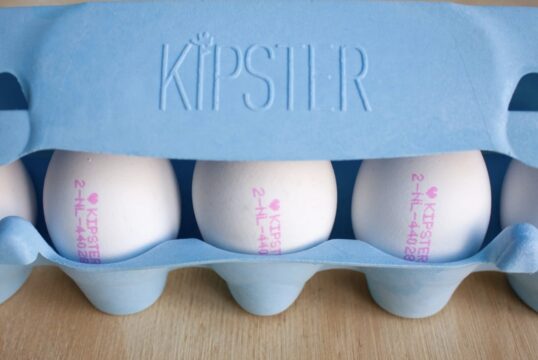
You may already have seen the distinctive narrow blue box at Lidl. And wondered, ‘three full Better Life stars but not organic, how exactly does that work?’ (Our supermarket visits are often roller coasters full of amazement). It’s possible, because although these chickens may not have a 100% organic diet, they do get an incredible amount of space and light and a pretty good chick life. The Dutch Society for the Protection of Animals appropriately rewards this company with those three stars. Meet Kipster.

Viva la Revolución!
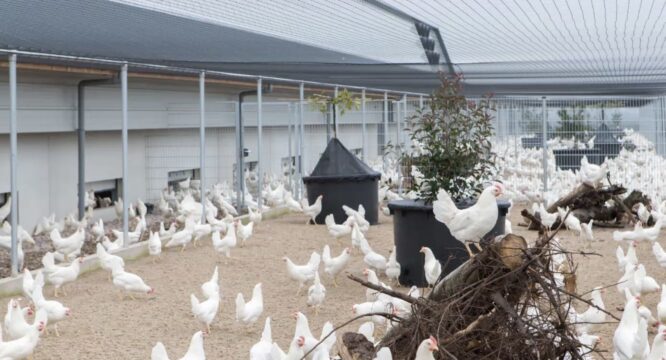
On a new mega-barn in Beuningen, just outside Nijmegen, the words ‘Revolutionary Farmers’ are emblazoned. Kipster is the chicken barn founded by, among others, former battery-farm owner Ruud Zanders, who made a 180º turn with the future in mind. It is the company’s second barn; the first opened in 2017 in Venray.
Mega-barn may not sound positive, but when you consider that relatively few chickens live here in relation to the surface area, it suddenly becomes more of a mega-palace. Wakker Dier, a foundation that does not mince words when publicly shaming brands or shops that do not take animal welfare seriously, has even enthusiastically advertised Kipster in radio commercials. Because, says Anne Hilhorst of Wakker Dier in De Volkskrant: ‘The design of the barn was conceived from the animal’s perspective and takes all aspects into account: the environment, feed, climate. This is an example of how it can be done and how it should be done.
Kind to roosters
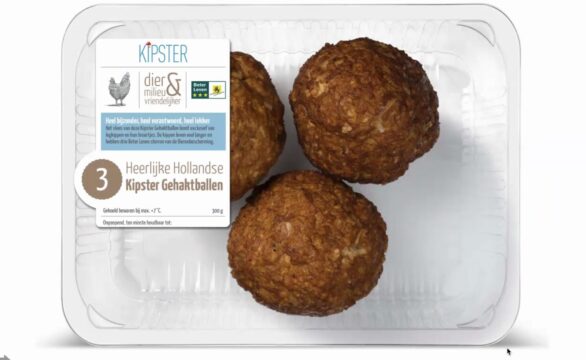
What’s extra great is that Kipster also takes responsibility for the male chicks. Wherever laying hens are kept, an equal number of male chicks are born. In the Netherlands alone, 40 million day-old chicks are gassed every year. Kipster refuses to participate in this. The brothers of the laying hens are raised on an organic farm. At 15 to 17 weeks, they go to a slaughterhouse. The male chicks are then used to make various familiar meat products sold at Lidl, such as Kipster meatballs. At Kipster, the male chicks therefore have a good life until they are sold as meat. Unique!
Chicken playground
There are even play structures for the chickens – Zanders firmly believes in a complete turnaround towards animal friendliness and sustainability. A striking detail is that he comes from a family of highly conventional farmers for whom progress almost always meant growth, by holding on to what you know. What followed was a brutal bankruptcy, which he now actually sees as his salvation. He knows better than anyone that traditional farmers feel under attack in the current social debate, and with the best will in the world he tries to convince them that change is inevitable.
‘After the Second World War, we thought: we must prevent famine from ever happening again. So the minister at the time proposed the idea of scaling up. Farmers began keeping as many animals as possible. But those systems are outdated… What it is really about is developing a vision of what our food system will look like in thirty years. Current agriculture is based on ideas from fifty years ago: producing as much as possible at the lowest possible cost. We have taken that too far,’ says Zanders.
Coming full circle
A more optimistic vision of the future is that of circular agriculture. This cycle means that fertile soil is used primarily to grow plant-based food for people, which we previously also wrote about, rather than as land for growing animal feed. Did you know that more than 70% of all agricultural land in the world is used for our livestock? This land use puts enormous pressure on our planet. That is why Kipster does not use fields to grow chicken feed – and that is also why its eggs are not organic, because to earn that designation, you have to grow organic feed. Chickens (and pigs) can instead be fed with residual streams (food waste, for example, such as the waffles from Lidl’s bakery used by Kipster). In this way, according to Zanders, animals once again become a useful link in the agricultural process.
Egg, egg, egg
Fortunately, more and more people are discovering Kipster’s delicious eggs. Not only consumers, but companies too. Albron, the largest independent corporate caterer in the Netherlands and, among other things, the caterer for Efteling, now works exclusively with Kipster eggs, and there are advanced plans (and formal commitments) to expand internationally. So you see: give a chicken a playground and you get a happy egg.
And that blue box? It is a genuine museum piece. The box is on display at London’s Museum of Brands Packaging and Advertising. It is the most sustainable egg carton there is, made from potato starch, cellulose fibres and water. It reduces the CO2 footprint by around 90% compared with a conventional egg carton. Kipster is doing an excellent job on every front!
Read also:
- Dilemma: milk in your scrambled eggs or not?
- 11 common mistakes when preparing eggs
- Recipe: soft-boiled egg from the Airfryer
Sources: De Volkskrant, De Gelderlander, Kipster


