


Limburgse vlaai protected from now on: what does that mean?
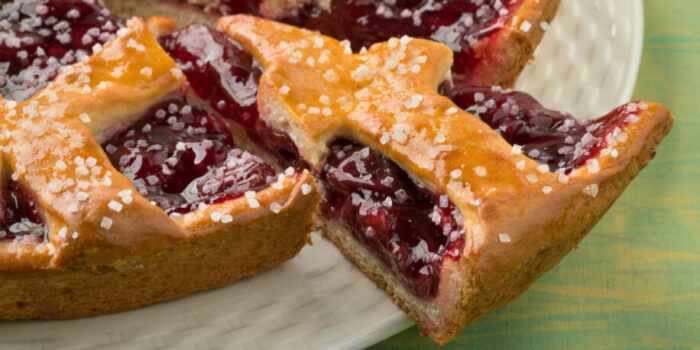
There’s a good chance you’ve eaten a (piece of) Limburgse vlaai at some point, or have at least heard of it. But if you’re a fan, you also know: there’s a huge difference between all the vlaaien. Naturally, you’ll find the very best at a bakery, but every now and then you may end up with a disappointing supermarket version. Hopefully, that will increasingly become a thing of the past, because stricter rules have been introduced for selling (and making) Limburgse vlaai.

This was done at the initiative of Dutch and Belgian Limburg bakers, who wanted stricter supervision of this — and they succeeded!
Not every vlaai may be called Limburgse vlaai
For example, one strict requirement is now that Limburgse vlaai must actually be made in Limburg. Just as champagne may only be called that if it is made in the region of the same name. It must also be a round tart that is fresh, golden-baked and has a diameter between 10 and 30 centimetres. I suspect that many modern vlaaien already fail the ‘fresh’ requirement…
Because they take that very seriously now: after baking, Limburgse vlaai may not be frozen again, otherwise it loses its name. But there are more requirements: the base must be made from yeast dough and may be no more than one centimetre thick — after baking. It is also important that you can eat a slice straight out of your hand, but that seems to me like the easiest rule to follow.
Strict ingredients list
No strange embellishments with Limburgse vlaai like the hundreds of variations we see of tompouce; Limburgse vlaai must comply with the standard ingredients list, and if you start experimenting with it, you’re selling ordinary vlaaien instead of Limburgse vlaai. The filling must consist of fruit, rice pudding, cream, semolina porridge, fresh cheese, sugar and/or eggs.
PDO
Limburgse vlaai may now join the ranks of other products with a Protected Designation of Origin (PDO), such as Noord-Hollandse Gouda, Noord-Hollandse Edammer and Boeren-Leidse kaas. As of 22 January (when these rules come into effect), they will also be included in the list of Traditional Specialities Guaranteed. That list already includes products such as Boerenkaas, Basterdsuiker, Hollandse Nieuwe and Suikerstroop; products that must be made/produced/obtained in a certain way if they are to be called that. Still quite a lovely list, and entirely deserved that Limburgse vlaai is now part of it — we’ll never again accidentally reach for an unappetising specimen.
Bakers had already been working on this for some time: a year and a half ago, they announced that they were going to work on it and they finally succeeded. Hats off!
Also read:
Source: NU.nl


