


Not all blender jars are the same, so shape does matter
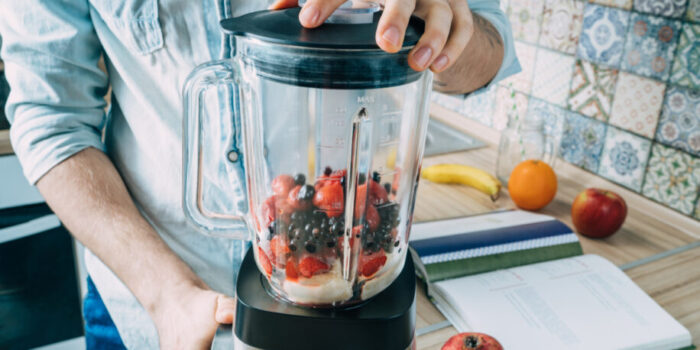
Our blender broke recently. It had been a cheap thing, it roared as if its throat were somehow being squeezed shut, and when it was really struggling with frozen fruit for a smoothie, it also gave off a strange motor smell. When I went online to choose a new one from dozens of options, there was one thing I did NOT pay attention to:

The shape of the blender jar. Had you ever thought about that? I hadn’t—not until the new blender had already been bought, delivered, and put into use for quite some time. Then I suddenly came across an article explaining why the shape of a blender jar really does matter. Who knew?
Call in the expert
The fantastic American culinary platform Epicurious called in the help of a bona fide design engineer to show why it matters whether the shape of such a jar is round or angular. This Vincent Valderrama set the drive mechanism of a cheap model on fire when he tried to blend almond butter in it, and showed even more interesting discoveries. Among other things, he explained this:
Everything matters
It seems logical that a €400 appliance will always beat a blender you pick off the shelf for €30 when it comes to blending technology. You can probably work out for yourself that this may have to do with how powerful the motor is and how sharp the blades are. But that isn’t the whole story. The shape of the jar also determines how good the result is, and what you are trying to make will also work better in one model than another.
Just like that fairground ride
In short, it works like this: if your blender has a super-powerful motor—and that quickly puts you in the more expensive category—it’s important that the jar is large enough to give the entire contents room to be tossed around wildly. But on top of that, the geometry has to be just right, so that everything being thrown around also ends up back in the blades for an even texture.
If such a powerful motor were fitted under a round jar, without any corners, certain forces would, according to Valderrama, cause all the food to be flung against the curved wall, where it would stay stuck until it was scraped off by hand.
Every job has its jar
So why aren’t all blender jars square? Because a different, less powerful motor apparently works much better under a round, often slightly smaller jar. For one thing, a less powerful motor can’t make optimal use of the space in a large jar; the motor simply isn’t up to it.
But if, for example, you want to make an emulsion, such as mayonnaise, a less powerful motor in a somewhat narrower round jar generally works better than in such a large angular one.
In both cases, of course, you need to make sure there aren’t too few ingredients in a jar that’s too large, because then it simply won’t work. And if you have the option of finding a blender with several possible interchangeable jars, that’s even more convenient.
Read also:
- The most delicious tomato soup ever simply comes from the supermarket (and this is it!)
- Why I can never make a smoothie normally again
- The difference between a food processor and a stand mixer
Source: Epicurious


