



Recipe for quick kimchi (Mak kimchi)
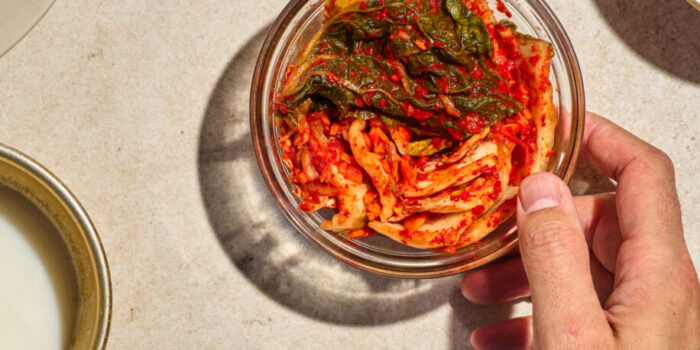
When you say ‘Korean food’, people quickly shout: kimchi. What exactly is kimchi? Pickled, fermented, spicy napa cabbage. The ripening process is somewhat similar to that of sauerkraut: you let it ferment in an airtight environment. The most important thing is that the kimchi ultimately has a soft yet crunchy and fresh flavor. The Korean word ‘mak’ means something like ‘willy-nilly’, ‘quick’ or ‘sloppy’. This kimchi takes less time to make than traditional kimchi, but is almost just as delicious.

When the SARS virus emerged in Asia around 2002, countries such as China and Singapore in particular were hit extremely hard. South Korea escaped relatively unscathed, with comparatively few cases. Guess how that happened? Kimchi, of course! According to Koreans themselves, this spicy, fermented napa cabbage helped them in the fight against the virus.
Kimchi is, after all, packed with probiotics, beneficial bacteria and antioxidants: all good for your immune system. It’s a compelling story, but it does make two things clear: Koreans are proud of their cuisine and they believe in the healing power of food. To this day.
The dish of all dishes
Kimchi is the dish of all dishes in Korean cuisine. Koreans eat it for breakfast, lunch and dinner. In the past, when ready-made kimchi did not yet exist, Koreans took it with them on holiday so they could still eat it in their destination country. Many Koreans of the older generation still shudder at the horror of a kimchi bag exploding in their hand luggage, with all their clothes inside.
How to make quick kimchi
- Cut the cabbage lengthwise into quarters, then cut each quarter into 5 pieces of approximately 5 x 5 centimetres.
- Put the sea salt in a large bowl with cold water and stir until the salt has dissolved. Add the cabbage and leave it for about 4 to 5 hours. The cabbage leaves should be completely submerged.
- Rinse the cabbage thoroughly several times under cold running water – otherwise it will be too salty – and drain well in a colander. You will notice that the cabbage has become softer, but is still crispy.
- Put the gochugaru, apple, ginger, onion and garlic cloves in a tall measuring jug and blend with a stick blender until smooth. Add the fish sauce and mix well. Set aside.
- Put the daikon, leek and carrot in a large bowl and pour the marinade over them. Mix well with your hands (preferably wear plastic gloves; it can sting quite a bit).
- Add the pieces of cabbage and mix well with the sauce and the other vegetables. Ideally, each piece of cabbage should be coated with the marinade.
- Put the cabbage in a glass preserving jar. With the lid firmly closed, leave the jar to mature for 4 days at room temperature (not in the refrigerator). Find a spot on the counter or in a corner of the kitchen where the kimchi can ferment undisturbed.
- After 4 days, you will have young but perfectly edible kimchi. You can then let the kimchi mature further in the refrigerator and keep it for up to 2 weeks. Generally speaking: the longer you let the kimchi mature, the fuller and stronger the flavor.
- It is best to store kimchi in glass jars, because kimchi will simply eat through plastic or your Tupperware. If you keep kimchi in the refrigerator, everything in the refrigerator will smell like kimchi after one day. But hey, you have to make some sacrifices for Korea’s national pride.

Title: The Bible of Korean Cuisine
Author: Sang-Ah Yoo & Myung-ki Min
Price: €34.99
Publisher: Carrera
In The Bible of Korean Cuisine, Myung-ki Min and Sang Ah Yoo take you on a journey through Korean cuisine. A surprising and healthy cuisine in which fermented ingredients such as kimchi, gochujang and doenjang, together with rice, noodles, all kinds of vegetables and seaweed, fish, meat and tofu, form the basis for an endless number of dishes.
Read also:


