



Restaurant De Dyck: for the adventurous diner who wants to be surprised
In Woubrugge, there’s a farmer who has completely changed course. After taking over his parents’ arable farm in 2003, he transformed it into a fine-dining restaurant with the ambition of becoming self-sufficient by 2025. And they’re almost there. Not a restaurant for the seasoned bistro-goer, but for the adventurous diner who wants to be surprised. Because surprised you will be at De Dyck—we experienced it ourselves.

With the 2025 deadline in sight, Restaurant De Dyck is now over 99% self-sufficient. In addition to producing its own ingredients, they are still working hard to make the business as sustainable as possible, including in terms of energy, clothing and, for example, banning the big, bad plastic piping bag, of which a dizzying number are used in the hospitality industry. The restaurant also caught Michelin’s attention; last year, a Green Michelin Star was awarded next door. Chef Martijn Koeleman is only 31 years old, but has already worked in Michelin-starred kitchens at La Provence in Driebergen and Restaurant Kasteel Heemstede in Houten. In addition to a kitchen team, he is assisted by a fermentation expert and kitchen-garden pioneer. Because the latter is ultimately at the heart of it all.
In the heart of the Green Heart
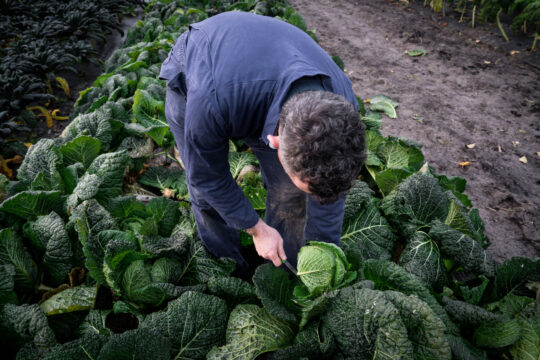
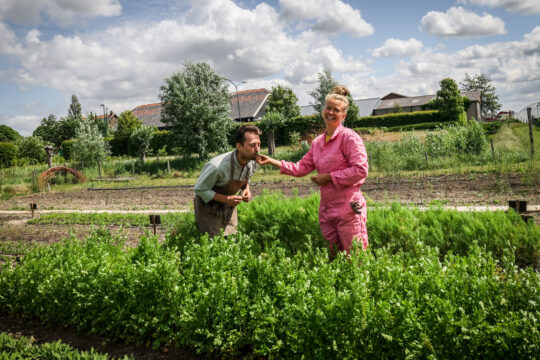
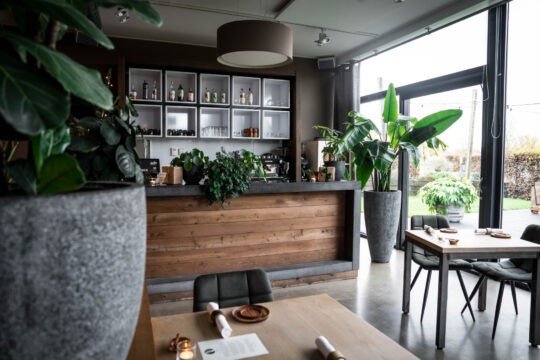
Flatter than flat is the polder landscape surrounding farmer Reinier Kempenaar’s farm. But it’s not truly remote: if you can aim reasonably well, you can toss your dart between Amsterdam, The Hague and Utrecht and start navigating. To make things a little easier, you can simply set your satnav for Woubrugge, right in the heart of the Green Heart. Drive under a little bridge and down a dike, and you’ll arrive at the 5,000-square-metre kitchen garden surrounding the farm. A modern cube has been built inside the old building to house the restaurant. It’s made of glass, so as soon as you enter, you immediately notice that you’re dining on a farm. From the tables, you look out over an old tractor and large wooden grain silos, one of which is used as a wine room. A serene mix of old and new.
A tour of the kitchen garden
The enthusiastic host offers us a lovely welcome drink in the form of Betuws Bruis, the non-alcoholic option we ask for. A little later, chef Martijn Koeleman appears and suggests taking a tour of the kitchen garden. While we are by now freezing in the fierce wind blowing across the polder landscape on this cold evening, Koeleman’s enthusiasm is undiminished. He guides us past the vegetables and herbs that make the restaurant almost one hundred percent self-sufficient, the fruit garden they are working hard on so they can eventually source everything from there too, and the refrigerated, drying and heating cabinets that make it possible to cook year-round with produce from their own land.
Remarkable: schools advise against internships at vegetable restaurant De Nieuwe Winkel**
From fermenting to drying and vacuum-packing
We ask what happens if the harvest fails one year. That has never happened so far, but with our own eyes we see all the ways they make use of every opportunity to prevent it. Every preservation method is used, from fermenting to drying and vacuum-packing. And how do they make up for shortages in winter? ‘In winter, our hens lay fewer eggs, so we work with more egg white, which you can freeze. We cure the yolks,’ the young chef explains. ‘In summer, all kinds of things grow, but in winter the menu is much heavier, for example, and the harvest is more limited. We balance that by using lots of ferments we made in summer.’
-

- Binnen bij de Dyck
-
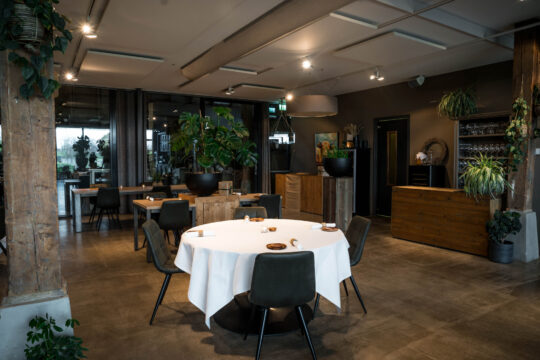
- Binnen bij De Dyck
De Dyck’s Kitchen-Garden Menu
But what does it taste like? We return to the pleasantly warm restaurant and, after a glance at the Kitchen-Garden Menu, begin our adventure. The menu is vegetarian at its core; fish and meat are optional. What immediately stands out are the ingredients that the average person probably didn’t know were edible, but mainly knows from the garden centre. That says a lot about the menu: you have to be open to experimentation. The menu changes according to the harvest, and the chefs are forced to make creative and sometimes unconventional choices.
Kohlrabi flower, magnolia, buttermilk and rhubarb
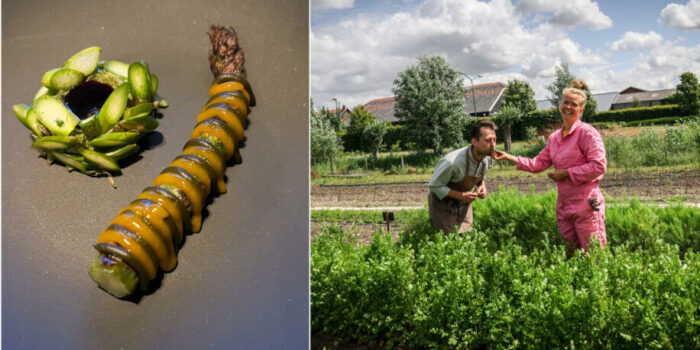
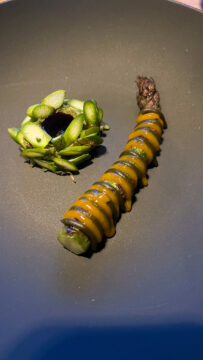
Overall, we think those choices are a hit. The amuse-bouches alone are little works of art and offer a whole range of flavours. The extremely irritating Japanese knotweed that overruns Dutch gardens is used here, for example, together with tomato and shiitake. The beauty prize definitely goes to the second dish: a flower of kohlrabi, magnolia, buttermilk and rhubarb. The green asparagus with pumpkin seed, codium and cucumber is also a picture, with the seed providing an interesting texture. All dishes in which the combinations work.

Homemade kombuchas
All the wines at De Dyck come from within a 500-kilometre radius. That means wines from Dutch soil to an area extending as far as the Champagne region, part of Alsace and, for example, Great Britain. We are usually great wine lovers, but during our visit we decided to be just as experimental as the restaurant itself. We opted for a non-alcoholic pairing with the menu, with one wildcard left to the sommelier. An excellent choice, because a (nearly) self-sufficient restaurant obviously doesn’t serve Fanta. Several homemade kombuchas pass by, our favourite being based on smoky celeriac and fresh tomato. There are also juices from Dutch fruit growers and their own produce, often featuring some of the same ingredients as the dish they accompany. Our wildcard arrives with the green asparagus, in the form of a pleasantly bitter pet-nat from the German Weingut Balthasar Ress, made from the Riesling grape.
An atomic bomb of flavours
The risk of self-sufficient cooking: experimentation can also go the other way. The corn tempeh with onion, radicchio and walnut is an atomic bomb of flavours that not everyone will appreciate. I finish my plate because it may not be my favourite, but I can still appreciate the idea and flavour; my dining companion gives up at this point. The same goes for the dessert, which is partly left uneaten; koji, a kind of wonder fungus that forms the basis for sake, soy sauce and miso, leaves a decidedly bitter mark on the dish, just as it did with the tempeh.

Bold choices like these make De Dyck a restaurant that comes with a disclaimer, but in our view they do not detract from the experience. They cook with so much knowledge, passion, love and respect for nature that you can forgive the chef if these elements briefly win out over flavour. As long as there is balance—but hey, we trust him completely on that.
Read also:
- OH YES! You can now buy ‘nduja at the supermarket
- Genius: this is what you use the tab on your bottle of sunflower oil for
- What is gochujang and what can you do with it?


