


‘Forced’ Checks at Albert Heijn Self-Checkout Counters Cause Controversy
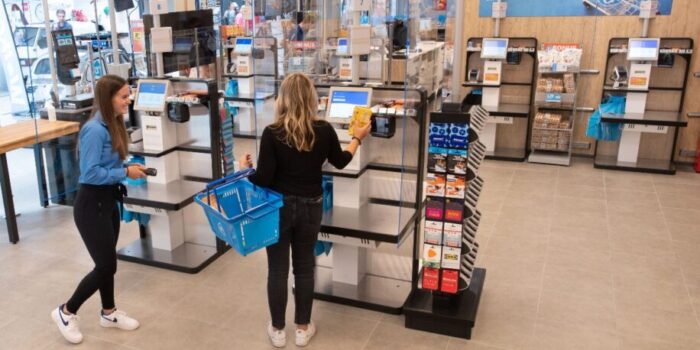
“Why me?!” may have crossed your mind before when you were the one who got picked at the self-checkout. Especially when you had just packed your grocery bags very carefully. You thought you were being clever and would be back outside nice and quickly… That why-me question has suddenly flared up again because of a situation at Albert Heijn. A list of rules at an Albert Heijn store came to light, and it included something about “forced spot checks.” Uh, what?

Weren’t those spot checks supposed to be completely random? Wasn’t being picked out at the self-checkout simply a case of really bad luck? Suddenly, we’re starting to wonder about that.
You don’t need to worry
Here is the list of Albert Heijn’s rules in question:
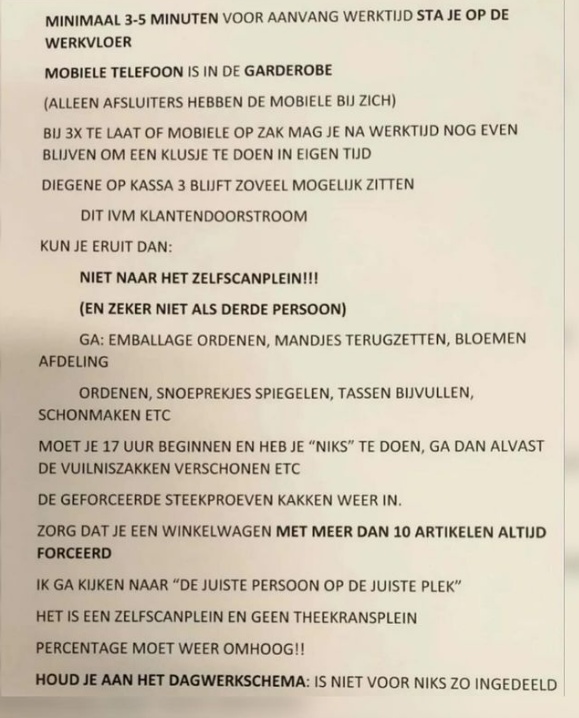
These rules caused quite a stir all over Instagram. The comments turned into something of a two-sided debate: people who found them utterly ridiculous, and people who actually approved. It was mainly about the extra minutes on the shop floor, tasks done in employees’ own time and the tea party at the self-checkout area. But one commenter noticed: “Why is nobody talking about the forced spot checks? I really thought I saw a sign yesterday saying: ‘You don’t need to worry if you are checked at the self-checkout area; this is not directed personally at you but is a standard procedure carried out at random’ (…).”
What a coincidence…
Spot checks at self-checkouts are supposed to be completely random. The checkout’s computer sends a signal to an employee, who then knows that a check needs to be carried out. It is generally known, however, that some products are checked more quickly. For example, if you are paying for alcohol, you can almost set your watch by an employee coming over to check your groceries. And apparently there are more triggers. For example, if you have a product in your basket that has often been stolen recently. Or if there is a very long time between activating the hand scanner and paying.
Triggers are also mentioned in the comments. “(…) It’s completely random. Checkouts that are frequently used, products that are often stolen in the system, if you remove items—these make a bell ring, which results in someone being checked (…)”, one comment reads.
… or is it?
So where do these “forced spot checks” come from? The note says: “Make sure you always force a check for a shopping cart with more than 10 items” (I’ll correct the spelling mistake while I’m at it). In principle, this means that an employee can personally pick customers for a check. “(…) The employees standing at the self-checkouts can force spot checks, and do so based on everything that person is buying. So if that person has 20 cans of Fanta, it’s quite possible that they only scan 18 of them, hence a forced spot check”, someone explains in the comments.
The question now is how far these forced spot checks go. If an Albert Heijn—or any supermarket, for that matter—does this, are there clear rules for it? As the note above states: does an employee carry out a forced spot check only when there are more than 10 products in the cart? Or also whenever there is suspicion of theft, for whatever reason? In short, does an employee go by their gut feeling, or are they not allowed to do that just like that?
Hours in jail after a mistake at the self-checkout: it happened to Marianne
Suspected misuse
A response on Instagram suggests that it may vary by AH store whether spot checks are random or can also be forced: “It differs per AH; we do them randomly.” The following can be found on the Albert Heijn website: “We monitor the proper use of AH Self-Checkout and carry out checks to establish whether the procedures for scanning all products and paying are being followed correctly. Among other things, an ICT system is used for this purpose. An employee will scan your groceries again. In the event of suspected misuse, we have the right to exclude anyone from using AH Self-Checkout. If a check shows that not all products were scanned after you scanned your (mobile) Bonus Card at the payment terminal, we consider this theft and may report it to the police.”
It has long been clear that self-checkouts encourage theft in supermarkets, and that more and more supermarkets are taking additional measures to tackle it. The question is whether supermarkets mainly do this with AI technologies, or whether forced spot checks are part of it too. And if the latter is the case, to what extent the store has strict rules for this. And, consequently, how fairly those forced checks are carried out.
Read also:
- Why some people shouldn’t be allowed to use the self-checkout
- 9 sneaky tricks supermarkets use to make you pay more
- 10 supermarket annoyances—does yours make the list too?
Image: Instagram @cestmocro


