



The secret of the famous Roquefort cheese revealed
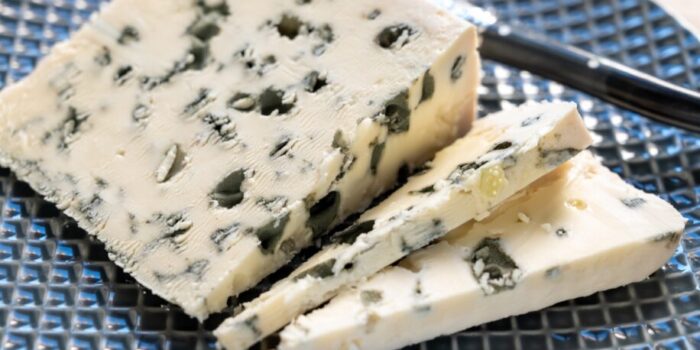
Oh, Roquefort! This creamy and tangy blue cheese delights (almost) every cheese lover. The secrets behind this famous French sheep’s cheese take us to deep caves in the south of France.

Here, in the village of Roquefort-sur-Soulzon at the foot of Mont Combalou, is Roquefort’s birthplace. According to legend, the cheese was discovered by chance when a young shepherd, enchanted by the sight of a beautiful girl, left his rye bread with young sheep’s cheese in the cave to follow her. He never found her.
Penicillium roqueforti
But perhaps his find in the cave, when he returned some time later, was much more valuable. There, the mould Penicillium roqueforti had transformed the cheese into a very special delicacy: Roquefort! A chunk of Roquefort does not work as a remedy when you are ill, but it is true that the blue mould Penicillium roqueforti in blue cheeses is a distant relative of the mould Penicillin, which formed the basis for antibiotics. It also gives the veins in the cheese that distinctive blue colour.
AOP
King Charles VI of France, who mentally deteriorated so much that his nickname became ‘the Mad’, awarded an AOC (Appellation d’Origine Contrôlée, now AOP) in a lucid moment—we are talking about 1411—to the area where the caves in which Roquefort had been made for centuries are located. This protected designation of origin for Roquefort means that the cheese may only be called Roquefort if it is produced in this specific region and according to strict rules. Just as sparkling wine may only be called champagne if it actually comes from the Champagne region.
-
- Op bezoek bij Roquefort Société
-
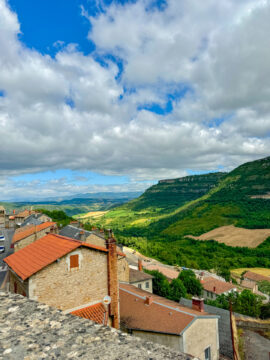

- Het dorp Roquefort-sur-Soulzon
How is Roquefort made?
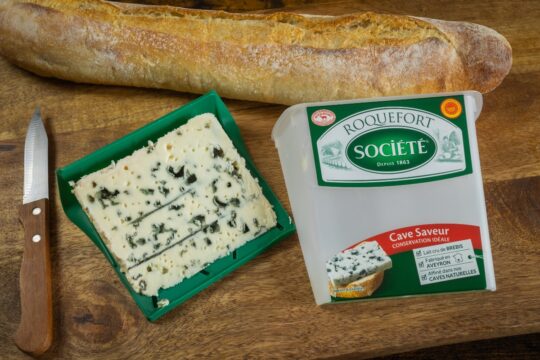
To understand how Roquefort is made, we visit Roquefort Société. They have been around since 1863 and welcome around 100,000 visitors a year who come to discover the secrets behind the famous cheese. There, we descend into the enormous underground network of deep, well-ventilated caves, the so-called fleurines. We learn that everything starts with raw sheep’s milk, from Lacaune sheep that graze on the peaks of the Aveyron Pyrenees. The sheep give milk from December until the end of June, so Roquefort is not made all year round. The milk is then heated to a maximum of 34°C and rennet is added, resulting in curds (the solid component from which the cheese is made).
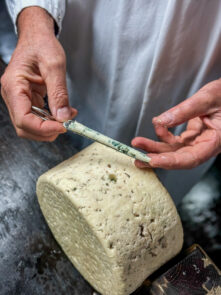
The curds are placed in moulds and Penicillium Roqueforti is added. This mould grows naturally in the caves of Combalou. The curds are then salted and pierced all the way through with needles to create air channels. The oxygen encourages the growth of the blue mould.
Cellar master
In the caves of Roquefort, the cheeses are placed on centuries-old oak shelves to mature for 14 to 25 days. The constant temperature and humidity in the caves are ideal for the mould to develop. During this period, the cheese is not touched. The only thing the cellar master does at this stage is take a sample to assess the cheese’s texture and mould development. He does not taste the Roquefort in the making—the cheese only tastes of mould at this point.
Is the time right for the cheese to age? The cheese is then wrapped in microporous aluminium foil and placed in special large refrigerators for three to six months for a controlled maturation phase. The cellar master’s expertise is now essential. Some refrigerators are colder than others and, alongside the Penicillium Roqueforti spores used (there are around 8,000!), this determines the final flavour. The colder it is in the refrigerator, the more subtle the flavour. If the temperature is raised, the mould develops more, resulting in a stronger flavour.
Roquefort on ontbijtkoek
The best is saved for last: a tasting of Société’s various Roqueforts. And so we discover not only the variety of flavours, but also the most surprising way to eat cheese. Blue cheeses, intense as they can be, work well with wines that lean towards the sweet side or are even distinctly sweet, such as Sauternes. But a sweet sparkling wine is surprisingly delicious too. Forget a cracker with your Roquefort and try serving it on a piece of ontbijtkoek! Continuing in the same vein, Roquefort is also delicious on toasted walnut bread.
Roquefort matures from January to July, so outside this period you will not see any cheeses in Société’s caves. A tour is still enjoyable (especially if you wear something warm—it is cold there!) You can buy Société’s Roquefort cheese at Gastrovino shops throughout the Netherlands.
Read also:


