



These are the biggest differences between Roquefort and Gorgonzola
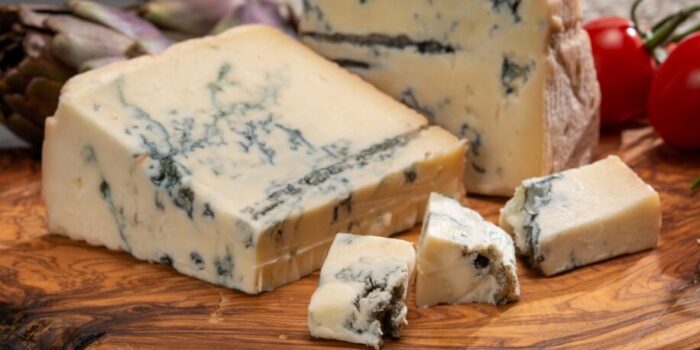
France has Roquefort, Italy Gorgonzola. What are the differences between these two blue cheeses, besides the fact that they both come from different places and are very hard to resist?

The cheeses have at least one more thing in common. You cannot simply produce them wherever and whenever you like. At least, not if you want to officially call them Gorgonzola and Roquefort. They are two protected cheeses. Real Gorgonzola is made in the Italian regions of Lombardy or Piedmont, while real Roquefort comes from the Roquefort-sur-Soulzon region (in southern France).
Cow’s milk or sheep’s milk
Cheese is made from milk. But as you know, not every cheese is based on the same type of milk. Gorgonzola, for example, is made from pasteurized cow’s milk. Roquefort, on the other hand, is made from unpasteurized sheep’s milk. Pasteurization means that the milk is heated, killing certain bacteria in it. Unpasteurized, on the other hand, means that the milk is still raw.
Different aging times
Gorgonzola and Roquefort do not have the same aging times. Roquefort usually ages longer: at least 90 days, with an average of 5 months. Some Gorgonzolas are removed from the aging room after just 2 months. They then taste quite sweet. If the cheesemaker wants a sharper, stronger flavor, Gorgonzola may also be left to age for 90 to 100 days.
Different appearance
Another difference between Gorgonzola and Roquefort is their appearance. You may not see huge differences with the naked eye, but they are definitely there. The biggest visual difference is in the rind. Gorgonzola does have one, with a kind of pinkish-gray color and a rough edge. Roquefort does not really have a rind, but rather a smooth exterior.
One difference that requires a slightly closer look can be found in the veins of the cheeses. They are created by different molds. Gorgonzola gets its veins from penicillium glaucum, while Roquefort gets its veins from penicillium roqueforti. The molds create veins in slightly different colors. If you look closely, you will see that the veins in Roquefort sometimes look blue-green, while Gorgonzola’s veins are somewhat bluer.
The flavors are different too
Finally, Gorgonzola and Roquefort certainly do not taste exactly the same. Gorgonzola Piccante, the Gorgonzola that has been aged longer, comes closest in flavor to Roquefort. Sharp, piquant and strong—that is how you could describe these flavors. Roquefort tastes even more pronounced in this respect. Both types of cheese have a fairly earthy flavor, but Roquefort has an even more prominent umami component and is somewhat saltier.
Gorgonzola Dolce is the short-aged variety of Gorgonzola. It tastes sweet, mild and creamy, with a slightly spicy touch. Perfect with this pear salad.
Textures
Both Gorgonzola and Roquefort have wonderful textures. An important reason why, besides their flavors of course, we love seeing them on a cheese board. Here too, the cheeses are not all alike. As mentioned, Gorgonzola Dolce is soft, creamy and smooth. The riper the Gorgonzola, the firmer and more crumbly it becomes. Yet you can still taste that creaminess in Gorgonzola Piccante. Roquefort is moister, denser and more crumbly. But what is so delicious about this cheese is that it melts in your mouth.
And now I’m off to the nearest cheesemonger—to stock up on my cheese supplies again.
Read also:
- Burgonzola: the love child of burrata and gorgonzola
- It’s proven: eating cheese before bed contributes to better sleep
- Cheese according to your zodiac sign
Sources: Any Cheese, Fine Dining Lovers


