


These 5 things about champagne you want to know
A drink more festive than champagne is unthinkable. At the same time, champagne is mysterious and often misunderstood. Because how exactly is it made, and what does ‘brut’ actually mean? And what’s up with Jay-Z’s champagne? Let’s refresh your knowledge.

Champagne is a labor of monks
The production of sparkling wine in Champagne began at the end of the 17th century. This is also the era of one of Champagne’s best-known personalities: Dom Pérignon (1638 – 1715). This monk was stationed by the church in Haut Villiers in 1668, and as cellar master he had an immeasurable influence on the style and perfection of champagne. However, unlike what is often assumed, he did not invent the bubbles. He probably devoted most of his life to preventing them. In French Limoux, a small town in Languedoc in the far south of France, monks from the Abbey of Saint Hilaire discovered how wine began to bubble, years before bubbles appeared in wine in Champagne. They still make sparkling wine here, exactly as they do in Champagne: called Crémant de Limoux. It costs much less, and you can throw quite a party with it too.
To blend or not to blend
The most important step in making champagne is the assemblage, blending the base wines – from different grapes, origins, styles and ages. Will it be a non-vintage wine (to which wines from older years, the vins de réserve, are added), or a millésime, in other words a wine from a single vintage (to preserve the style of a particular year), a rosé Champagne or a blanc de blancs (made only from white grapes), a blanc de noirs (made only from blue grapes) or a monocru (from a single wine village)? Choices, choices!

Brut is the house style
Most champagnes come from the Grande Marques (literally: a great brand), such as Billecart-Salmon, Veuve Clicquot and Ruinart, each with its own history, tradition and house style: the characteristic brut. Officially, the designation brut on a champagne bottle refers to the amount of sugar added to the champagne at the very last moment (for a brut: <12g). For many large houses, however, more is at stake. Their non-vintage brut is their calling card and showcases the style the house stands for. Most champagnes are therefore made in this style, and the quality they manage to produce year after year is an achievement of unprecedented scale.
Cellar treasures
In Champagne’s 200-kilometer-long underground network of tunnels, around 980 million (!) bottles are ageing. And during that ageing – an ordinary champagne remains in the cellar for at least 15 months before being sold, while a millésimé remains for at least 36 months – a remarkable process gradually unfolds. When the dead yeast cells break down after 12 months, the typical characteristics of an exceptional sparkling wine emerge. First of all, a softer, creamier mouthfeel and, if the bottle is given real time (more than two years), new aromas also develop: hazelnut, almond, toast and a honeyed richness. O, amore!

Size matters
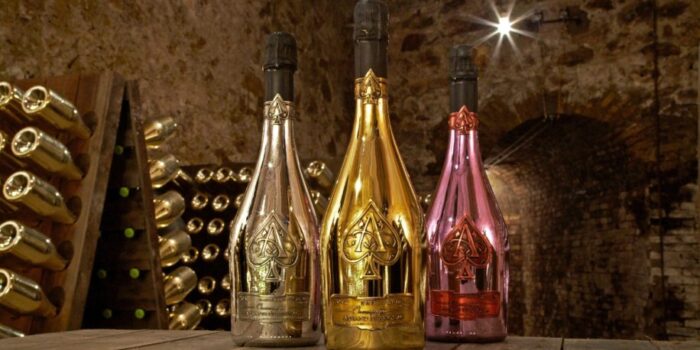
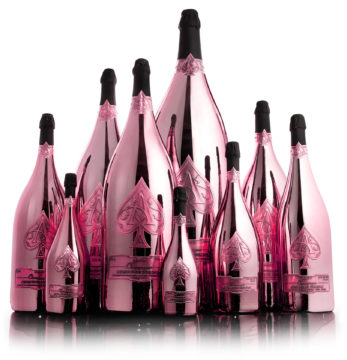
From the solo drinker (0.2l) to the party crasher (30l), every champagne bottle has its own name. There are 14 bottle sizes, from the small Piccolo, a ‘quarter’ of a standard bottle, to the Melchizedek or Midas, which is 40 times larger than the standard size. The only producer of such a bottle, around 6 bottles per year, is Armand de Brignac, also known as Ace of Spades, the champagne house that has been owned by none other than Jay-Z for several years. The Armand de Brignac Brut Gold is almost one and a half meters tall, weighs more than 45 kilos and is filled with 30 liters of famous bubbles. That comes with a price tag. For around € 50,000, it’s yours. Bargain, right?
Also read:


