


This is what we ate in the 1960s, part one
Some people rebelliously grow their hair to look like the Beatles, while others try out Elvis Presley’s obscene hip movements in front of the mirror. But most people in the 1960s stick to beans, potatoes and a slice of pork belly. Culinary highlights from this era: the first factory-made bread, King Corn, and pork chop with fries at the Chinese restaurant.

I’m going to live with Japie
A little boy packs his things, his dog and his coat and says: ‘I’m going to live with Japie.’ Why? His parents have King Corn bread, and it’s so delicious! King Corn is the very first factory-made bread in the Netherlands. What makes it special: it stays soft and fresh for a very long time. It is hugely popular for a while, but disappears from the shops again. Many people find it inedible; even Member of Parliament Gerda Brautinga says the factory-made bread has ‘neither crust nor flavour’. The company insists they were simply ahead of their time.
Are you saving up for the fridge?
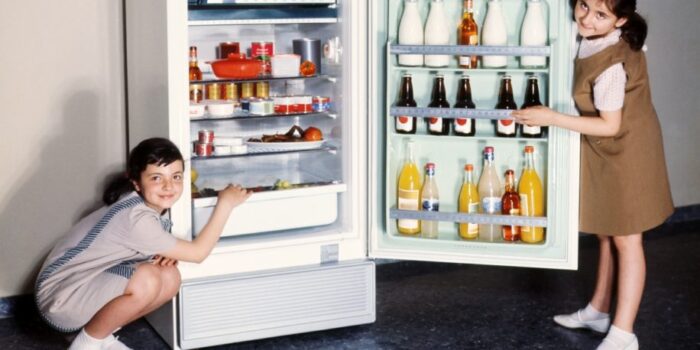
In the 1960s, many households still do not have a refrigerator, but that is about to change, thanks to Albert Heijn’s Premie van de Maand Club, a savings scheme through which loyal customers can save points for household appliances. The first bonus item is the refrigerator. That changes everything: being able to store food means you no longer have to go to the greengrocer, butcher and milkman every day.
Make room for the television
More and more families get a television at home. Can we all sit on the sofa and watch Kennedy’s assassination, or the moon landing, together? How cosy! But where should we put the thing? In most households, it gets pride of place; the chairs are arranged so that you can see the TV properly from everywhere, and some people even buy a three-piece suite. That means the dining table has to make room. While most people still eat together at the table, set with a tablecloth and food served in dishes, over the course of the 1960s the daily meal becomes much less important than the television programmes.
Husse husse with your nose in between
What are we having for dinner tonight? While in America Julia Child is seducing the entire continent into cooking French food, and in France top chefs such as Paul Bocuse and Michel Guérard are on the verge of reinventing French cuisine, in the Netherlands we are still dutifully eating potatoes, vegetables and meat every evening. Highlights of this era: slavink (invented by a butcher in Hilversum), pork belly and, of course, sausage. Bon appétit!
Spaghetti riot
The occasional home cook who makes macaroni serves it overcooked, alongside green beans and pork loin, as a substitute for crumbly potatoes. No wonder Italian guest workers, who often live in boarding houses and eat whatever is served, start protesting. In Beverwijk, near the Hoogovens steelworks, the protest against traditional Dutch fare escalates into a spaghetti riot: Italian men working at the steel factory have had enough. The staff magazine says: ‘These people are just as horrified by butter and potatoes as many of us are by olive oil and garlic.’
Pork chop at the Chinese restaurant
How about eating out, then? A 1961 survey shows that 83 per cent of people never ate out during this period. Nevertheless, more and more restaurants gradually appear. Chinese restaurants had already existed in major cities before the Second World War, but their businesses only begin to flourish in the 1960s. Marga Chong, daughter of the owner of Ling Nam on the Binnenbantammerstraat, recalls: ‘People asked: nasi is those little grains, right, and bami those strands. They didn’t know our cuisine.’ Her father takes into account people who do not like any of it and do not want to try it either. On the restaurant’s first menu, alongside babi pangang and spring rolls, there is also pork chop with fries and vegetables, under the heading Dutch dishes.
Read also:
- This is what we ate in the 1970s, part one
- This is what we ate in the 1970s, part two
- This is what we ate in the 1980s, part one


