


This is what we ate in the 1970s, part one
How gezellig, the seventies! Sitting on the sofa in your pyjamas watching Q&Q and Stuif Es In and feeling immensely proud listening to ABBA on your cassette tape. The culinary reality of the seventies was considerably less rosy. Highlights: a drink made with coffee creamer and 7Up, sausage rolls with a pickle and elbow macaroni.

New: elbow macaroni with luncheon meat
On holiday in Spain, France and Italy, travel-hungry Dutch people got their first taste of things like spaghetti, bouillabaisse and paella – and they wanted more. Back home, recreating those exotic dishes was quite a challenge, especially because mushrooms, bell peppers and courgettes were not yet available in every supermarket. Macaroni sometimes appeared on the menu, but in the Dutch version: elbow macaroni with cubes of luncheon meat, pieces of cheese and a dollop of ketchup or one of those mini tins of tomato purée. Sprinkle some Swiss cheese on top, and enjoy! Over the course of the seventies, packets of instant sauce for spaghetti and macaroni from Knorr and Maggi appeared on the market, a mysterious red powder with pieces of dried vegetables, and Conimex introduced the first spice mix for Nasi Goreng in supermarkets. It all looked very gezellig, as evidenced by the 1979 commercials.
Just cut it out of Margriet
How did Dutch housewives learn to cook something other than potatoes, meat and vegetables? Margriet and Libelle featured an increasing number of foreign recipes. Jon Verriet, a PhD candidate at Radboud University, looked into it: from 1950 to 1970, the number of exotic recipes in women’s magazines rose from 18 to 38 per cent. The editors made things easy for home cooks: instead of bread with an authentic coq au vin, it was perfectly fine to serve potatoes, and bouillabaisse could easily be made with herring. The Margriet Cookbook was the standard reference work for many housewives. The book included advice on cooking vegetables thoroughly (endive: forty-five minutes), recipes for classics such as lammetjespap (warm milk, flour and optionally a little brown sugar, brrr), and tips for setting the table and serving.
Chin. Ind. Lotus
Eating out became more commonplace in the seventies. More Chinese restaurants opened, with the standard aquarium, red lanterns hanging from the ceiling and, of course, réchauds. Metal dishes of babi pangang, foe yong hai and nasi goreng were placed on them – essentially Indonesian dishes adapted to Dutch tastes: deliciously sweet, not too spicy and with plenty of meat. Not in the mood for Chinese? Try a pizzeria instead, complete with a fishing net and Chianti in straw-covered bottles hanging from the ceiling, or pick something up at the toko.
Visitors, visitors, a house full of visitors
Friends came over for an evening or the neighbours dropped by for drinks. What was it like in the seventies? Wine glasses filled with cigarettes stood on the table. It was sensible to buy a little of everything: filtered, unfiltered, cigarillos and perhaps menthol cigarettes for the ladies. What did we drink? Mostly medium sherry or vermouth. Some men drank beer, some people preferred wine, such as Kellergeister or Alte Weintradition, or a little jenever. The designated driver did not exist yet, but some people still preferred something soft, such as Exota or champagne pils, with a flavour somewhere between cola, ginger ale and nail-polish remover. Children turned that soft drink into a Spoetnik: a layer of coffee creamer in a tumbler, a spoonful of sugar, then topped up with 7Up or Exota to make a creamy (and rather disgusting) mixture.
Here it is: the devilled egg
Of course, snacks were also served with drinks. Hits in the seventies included the devilled egg, a ham roll with an asparagus spear (from a jar), the classic pickle wrapped in a slice of sausage or, more daringly, a quarter of a hard-boiled egg in a slice of smoked beef. The occasional daring housewife went all out with homemade cheese puffs. The party was not complete without a platter of slices of liver sausage and cubes of cheese topped with a piece of stem ginger or tinned pineapple. And you did not simply put those snacks on the table and shout, ‘tuck in!’ – a good hostess regularly walked around with the platter and offered every guest a bite.
Check the insurance policies, we’re having fondue!
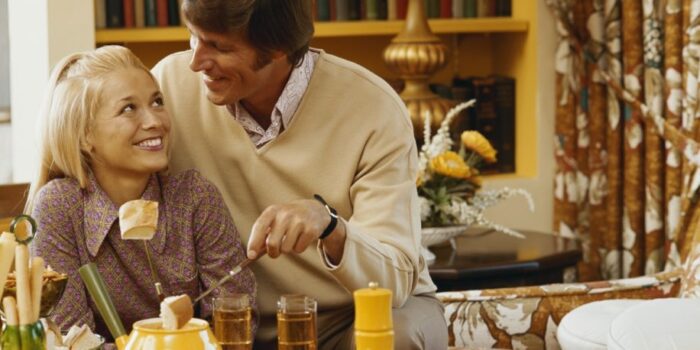
Think the house reeks after your guests have smoked their way through your supply of cigarettes and cigars? Then you have never had fondue, a culinary novelty in the seventies. Fill a small pan with salad oil, heat the oil over a methylated-spirit burner and, with the whole family gathered around the table, dip skewers of chicken, beef strips or small meatballs into the boiling oil. Serve with pieces of baguette, slices of cucumber and Duyvis sauces, and enjoy the penetrating smell that lingers in your house until you have aired everything out and collected the curtains and net curtains from the dry cleaner. It is a wonder that people who grew up in the seventies did not all suffer burns from head to toe, because the ingredients for a major disaster were wobbling right in front of you on the homemade tablecloth during a fondue evening: a pan of boiling oil, a methylated-spirit flame and the inevitable drip candle in an unsteady wine bottle. But it was gezellig.
Also read:


