



This is why truffles are so scarce, aromatic and extremely expensive
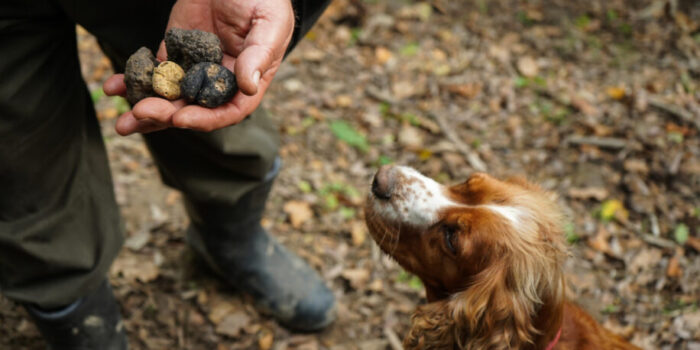
One of the most aromatic and exclusive delicacies found on the planet: truffle. Where does it come from? What varieties are there, and how can you best bring out that sensational flavor? We’re telling you everything about the celebrated truffle.

They are wonderfully mysterious; misunderstandings abound about the underground fungi we call truffles. And that has always been the case. For centuries, these ‘devilish things’, as people saw them, were not eaten at all. Now they are more sought-after than ever. Truffles are found all over the world, by the way; there are around 200 species in Europe alone, but most of them are of no culinary interest whatsoever.
Truffle hunting
Truffles are not easy to find. To be precise, a truffle is a fungus that grows underground, attached to the roots of various tree species. The tubers are equipped with a striking lure: aromatic compounds comparable to pheromones, the sexual attractants of humans and pigs. Pigs have therefore traditionally been used to search for truffles, but this comes with a risk. Pigs tend to eat the truffle they find immediately. This is why searching for truffles with a pig is prohibited in Italy. A more accessible way to find truffles is with a dog.
Cavatori
Truffle hunters in Italy are called cavatori. The most famous hunters come from the Norcia region, but there are also many in Umbria, Tuscany and Piedmont. The search for truffles is serious business, and every cavatore must have a valid permit; enforcement is very strict. There are severe penalties for searching for truffles illegally. Truffle hunting is a profession passed down from generation to generation. But that seems to be coming to an end. The truffle hunter’s way of life is under threat of extinction. The reasons include deforestation and a lack of young people interested in a life as a truffle hunter.
Black truffle
The best-known truffles can be distinguished by two colors: black and white. The most famous and most widely used truffle is the black truffle (Tuber melansporum). It is black in color and lightly veined. Black truffles grow all over the world, but the most sought-after is still the French Périgord truffle. You can recognize black truffles by their earthy taste and aroma, which come out even better when heated. The scent is reminiscent of musk or juniper. Black truffles are harvested from December to March, but they are at their best from mid-January.
White truffle
The white truffle is Italy’s pride and joy. The Italians even have a lovely saying about it: ”Chi li prova, diviene il suo eterno ammiratore” – whoever tastes it becomes its eternal admirer. The white truffle (Tuber magnatum Pico) is light brown on the outside and beige with white veins on the inside. The white truffle is much rarer, more complex, more delicate and stronger in flavor than the black variety. It has a more intense aroma—and because the aroma and flavor of the white truffle are so sensational, it should never be used in a sauce. Only served freshly shaved over pasta, risotto and egg dishes. And let’s not forget the difference in price. Black truffles usually cost between €600 and €1,200 per kilo. Prices for a kilo of the white variety can rise to as much as €7,000! Prices naturally depend on the season, origin and size of the harvest.
How to use fresh truffle
Have you acquired a fresh truffle? Handle it with care. Get a fine Microplane grater for paper-thin slices. The flavor of black truffle comes out best when it has been heated and allowed to infuse for a while. Another delicious option: shave a few pieces of your truffle and let them infuse in extra-virgin olive oil. Voilà, you’ve made your own truffle oil! Store your truffle in a sealed container on a piece of newspaper or paper towel (this absorbs moisture) in a dark place. The truffle can be kept for a maximum of two weeks.
Truffle oil
It’s best to leave the truffle oils you find in supermarkets alone. This synthetic stuff does give off an overpowering truffle aroma, but that is its only connection to the underground fungus. The ooh-la-la feeling created by the aroma abandons you as soon as you take a bite. But good news: genuinely delicious truffle oil does exist!
Olive oil producer Valderrama has a white and a black variety—and both truffle oils are made with Spanish Ocal olive oil, the mildest and most delicate variety. The natural truffle flavor is obtained by drying the truffles in a controlled process, followed by a maceration process (cold infusion). The truffles are then combined with the olive oil through infusion. Ideal for making low-budget truffle pasta in no time! Or, also incredibly delicious: truffle fries!
Also read:


