



‘Too Much Vegan’ at the Paris Olympics: Athletes Complain
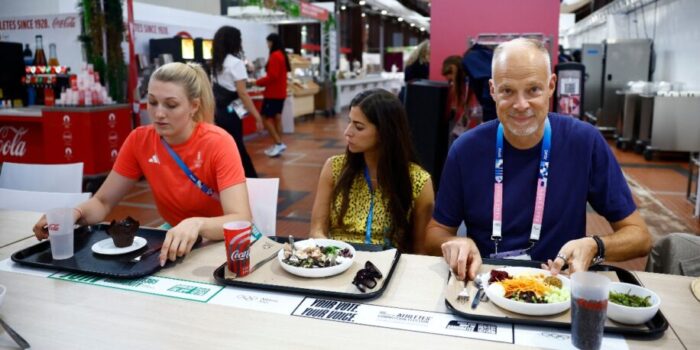
There’s currently quite a fuss about the food at the Olympic Games. Many athletes are expressing their dissatisfaction with what’s on offer. The most striking complaint? Athletes find all the food ‘too vegan’. They’re missing their protein bombs—in other words, meat and eggs. Why was it decided that at least 60% of the food should be plant-based for such a major sporting event as the Olympic Games, when most athletes get their protein from meat, eggs and quark?

The main reason for offering a large proportion of vegan food has to do with the environment. ‘More plant-based, more local, more sustainable and just as tasty,’ writes Tony Estanguet (president of the 2024 Paris Olympic Games) in the ‘Food Vision’ report for the Games. There is an ambitious goal: to halve the event’s CO2 footprint. The number of vegan meals was therefore increased by 60% at all Olympic venues and by 30% in the athletes’ cafeteria. This was to the annoyance of quite a few athletes and their staff. In response, 700 kilos of eggs and an extra ton of meat were brought in.
Then We’ll Do It Ourselves
Andy Anson, the managing director of the British sports team, told The Telegraph that many cafeterias at the Games were seriously short of eggs and chicken. The team therefore flew in two private chefs. They are now preparing meals in Clichy, a few kilometres from the Olympic Village. Many British athletes prefer eating in Clichy rather than at the Games themselves.
The Korean sports team also chose to fly in their own chefs. No fewer than fifteen chefs and nutritionists are making sure the Korean athletes are properly fed. They had meat, milk, vegetables and fruit brought in from France, but also 1.5 tons of rice and grains and half a ton of kimchi and herbs flown in from Korea. Don’t ask a Korean to live without kimchi; they’ll make sure to get it themselves.
Vegan Elite Athletes
In recent years, a vegan diet has become increasingly popular among athletes. The documentary The Game Changers illustrates this well. One well-known vegan athlete is Formula 1 driver Lewis Hamilton, who has sworn by a fully plant-based diet for years. And there are many others. Think tennis players Novak Djokovic and Serena and Venus Williams. They feel good on it.
A vegan diet for elite athletes is therefore not impossible. This is clear from the successful athletes mentioned above who have embraced it. But the scientific reality is that proteins are essential for human functioning, and that you obtain complete, high-quality proteins almost exclusively from animal-based foods. They are needed for the growth and maintenance of your muscles, as well as for delivering peak performance.
Plant-Based vs. Animal-Based Proteins
Plant-based proteins are also good for you, but they are less biologically available than animal-based proteins. This means you have to eat more plant-based food to get the same amount of protein as you would from animal protein sources. According to some researchers, this can range from 20 to 50%. Only then do you get the same amount of essential amino acids (especially leucine) as from animal proteins, which trigger muscle-repair responses.
Delivering Peak Performance
Why wasn’t this thought through a little better in advance for the Olympic Games? Having vegan options at such a major sporting event is absolutely a good thing. There are undoubtedly elite athletes who do follow a vegan diet. Who knows what the future holds in this area, too: research is ongoing. And indeed, a 60% vegan offering is not 100% vegan. But at a mega-event like the Olympic Games… Thousands of athletes are taking part, having worked towards this moment for years. They want to deliver peak performances, peak at the right moment and go for gold. Then you need to ensure (right from the start!) that there is enough good food to support that: protein-rich food, in other words. And you simply get that best and most easily from animal protein sources. Period.
I know that this article could land me on the vegan pyre (just as happened to my colleague Wieke), but I’m willing to accept that.
Also read:
- My vegan sister-in-law can get lost
- Honestly: all these products are vegan
- Students make a vegan bitterbal that is unbelievably delicious (and slightly improves the world)
Sources: Unsettled Science, Salon


