



What is that white mold on your sausage??
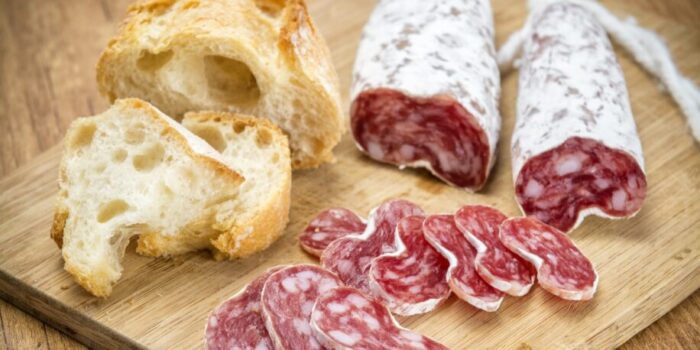
Thinly sliced cured sausage is a common feature on a drinks platter. You can buy fuet, salami or cervelaat hanging from a rack almost anywhere. But while the cured sausage hangs there, we notice something: the white layer on the outside. What exactly is that? Keuringsdienst van Waarde investigated it for us.

As you may know, when it comes to cheese, the mold rind is part of the flavor. People happily eat red-, white- and blue-veined cheeses. Just like with cheese, the white exterior of most cured sausages is also mold. One that is harmless, and that you can safely put in your mouth.
What is that white mold on your sausage?
This moldy layer gets onto the sausages because, before the drying process, they are first submerged in a mold bath containing starter cultures. These cultures then ferment, after which the sausage is aged. In the meantime, the white exterior develops. And it is quite useful. Just like with cheese, this layer of mold protects the sausage against bad bacteria, meaning it keeps for longer.
With or without mold
Interestingly, you can buy sausages both with and without a white outer layer. That is because allowing the outside of the sausage to develop mold is mainly something done in countries such as Spain and Italy—and because of the warm climate. This happens less in the Netherlands. Here, the sausages would have to dry in special climate-controlled rooms, but for many producers, time is money.
Still, there are also sausages on the market with a fake layer. Because the white exterior is thought to give the sausage an ‘artisanal’ appearance, some producers dust the sausage with rice flour. And that, of course, is precisely not the intention.
Also read:


