


Airplane food: this is what you need to know
Wines and dishes taste different on the ground than in the air. For example, salt and sweetness are perceived less strongly. Food served on board is therefore often more heavily seasoned. But what else should you pay attention to when choosing what to eat and drink on board? We asked KLM Food Specialist Ad Visbeen.

Research has shown that the olfactory and taste receptors work around twenty percent less effectively at high altitude in an airplane than on the ground. This is partly due to the low cabin pressure and the humidity on board. As a result, the oxygen level in the blood can change, which affects the receptors in your taste buds.
A pinch of salt
That is why some dishes simply work much better than others. Ad: ‘Stews, curries and lasagna all work well on board because the flavors of the herbs and spices used have had a long time to infuse. In the past, an extra spoonful of salt was sometimes added, but nowadays meals are seasoned using herbs and products from the umami spectrum, such as soy, fish sauce or anchovies, mushrooms, tomato, miso, truffle, olives and even seaweed. Tomato juice actually tastes much better on an airplane; the air pressure enhances the umami flavor.’
Acidity for more flavor
For years, KLM has offered meals developed by top chefs in World Business Class. The famous three-Michelin-star chef Jonnie Boer has been ‘mile high chef’ several times. Jonnie pickles all the vegetables for airplane meals, because that acidity has a positive effect on the food, just as acidity is so important in white wine. You do not necessarily taste ‘sour’; you taste the flavor of the product much more strongly. For example, a pickled carrot tastes much more like a carrot in the air than when it has not been acidified, he once told us.
Popular airplane meals
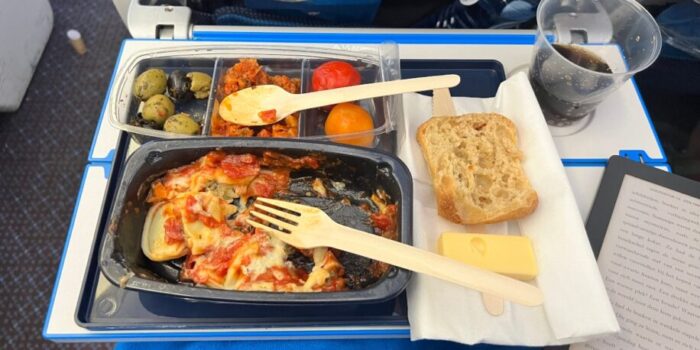
KLM works with 4 cycles per year featuring different menus. Ad: ‘Chicken is by far the most popular dish on board. And in Business Class, beef tenderloin steak performs very well. Pasta with tomato sauce, cheese and vegetables does better than pasta with a cream sauce.’ The stroopwafel and the croquette sandwich are also firm favorites, as are Dutch cheese and mashed-potato dishes with meatballs in Economy Class. Ad: ‘In Business Class, we try to put as many typically Dutch ingredients on the menu as possible, such as white asparagus when it is in season.’
No-go’s for airplane food
The notorious durian fruit is subject to an actual flying ban; the unbearable stench this fruit gives off would send every passenger running for the emergency exit. But there are more ingredients you would rather not have on board. Ad: ‘We try to avoid as many types of cabbage as possible that produce an unpleasant smell after reheating. Using too much garlic and onion is also not a success. And fried food becomes soggy and greasy. Since airplane meals have already been cooked and therefore already undergone one preparation process, they are reheated on board in a convection or steam oven. Not all products are suitable for this.’
‘Because the meals are always covered with a lid, it is difficult to create a crisp texture or a nice crust. Sauces thicken a little and some vegetables may change color. This is prevented by using thin sauces based on butter and flour rather than thick ones, and instead opting for a reduced gravy.’
These airplane wines give you wings
Wine on board is very important to an airline, especially in Business Class. Every year, around 480,000 bottles of red and white wine and 110,000 bottles of Champagne are served in this class at KLM. That is why airlines seek the advice of a tasting panel when selecting their wines. Because not only food, but wine too tastes different high in the air than on the ground. Due to the difference in cabin pressure, dehydration of the salivary glands and recycled air, wines present very differently in an airplane seat than they do at home on the couch.
Tasting red wines is more difficult in the air than tasting white wines. Wines with a high tannin content and lots of oak, for example, clip your wings. On the ground, those tannins may barely be noticeable, only to suddenly become unpleasantly prominent high in the air. Fruit-forward wines with round, soft tannins are more flavorful. White wines with the most pronounced aromas perform best in the air.
Ad: ‘Shiraz, Merlot, Chardonnay and Viognier are popular wines on board. It is important to drink plenty of water alongside the wine; then the flavors come through even better.’
Crew: never the same
And you do not need to worry that the crew will collectively get food poisoning on board. Quite apart from the fact that airplane meals meet the highest food safety standards, KLM makes sure that there is always a different option for the entire cockpit crew, because they are not allowed to eat the same meal on board.
Read also:
- KLM has recruited Brazilian celebrity chef Rodrigo Oliveira for its on-board meals
- Unbelievable: this is what airplane meals looked like in the 1960s
- Pringles has a Passport range with flavors you’ll want to try right now


