



Burgundian indulgence: how to make a Limburg borrel board
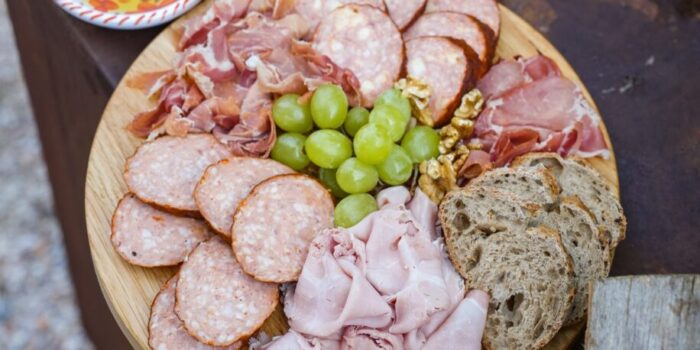
Spanish chorizo, Italian Parma ham and French saucisson sec; we usually cross borders when putting together a delicious borrel board. Why not look a little closer to home for once? As the most Burgundian province in our country, Limburg has plenty of delicious things to offer. It’s simply a matter of patience… before we all start enjoying Limburg borrel boards.

Drinks, Limburg and Burgundian living: it sounds almost like a holy trinity. When we say ‘Burgundian’, we mean things like ‘enjoying life’ and ‘the good life’. But what does ‘Burgundian’ actually really mean? And what exactly does a Burgundian lifestyle, which fits Limburg culture so well, entail?
Enjoying life with a big (soft) G
The origins of Burgundian living lie in France around the year 1400. At that time, the dukes of Burgundy ruled the northeast of the country. From the city of Dijon, they built a large empire that also included parts of Holland and North Brabant. Those Burgundian dukes lived quite lavishly. Luxury, splendor and grandeur, but also liters of wine and enormous quantities of calorie-rich food were part of their lifestyle. They enjoyed themselves, with a big (soft) G.
If you’re planning a weekend in Limburg, you’ll undoubtedly read that a Burgundian weekend awaits you. The people of Limburg are masters at enjoying life in Burgundian style. And what else would you expect, with the highest concentration of vineyards in the country? And with Limburg vlaai as a protected regional product? Vlaai may not really be borrel-board material, but the following Limburg regional products certainly are. Plus: we’ll recommend a delicious wine from one of Limburg’s renowned wine estates.
1. Livar charcuterie
You almost wonder why you would serve Spanish chorizo when you can also choose pork sausage from Livar. Livar stands for ‘Limburgs Kloostervarken’ (Limburg monastery pig). The Livar concept originated with the monks of Lilbosch Abbey in Echt, Limburg. What does that concept involve? Above all, that the pigs are treated incredibly well. They roam outdoors (with curls in their tails) and are fed grains from their own fields or local farmers. Truly Limburg pigs.
When you put love into something, you get it back. And you can taste that in Livar’s delicious, high-quality meat. Livar cold cuts are mature, satisfyingly fatty and natural in flavor. Melting on your tongue, just as we like our meat to be. Fill your Limburg board, for example, with smoked farmhouse ham, Prosciutto di Monastero, smoked ribeye, grill sausage or Livarano: a wonderfully seasoned and dried sausage.
2. Meatloaf from Saveurs
In the south of Limburg, you’ll find more than just vineyards. The minced meat from Saveurs also comes from there. Comfort food at its finest; the grandmother of owner Jean-Paul used to make her minced meat in a large red Creuset pot. Her flavors are still central to Saveurs’ minced meat. Just like the craftsmanship. Their meatloaf, for example, is still shaped and breaded by hand.
Saveurs’ meatloaf is a household name in Limburg. A slice on the borrel board is almost as self-evident to a Burgundian Limburger as celebrating Vasteloavend (carnival). It simply belongs there! You’ll make the meatloaf taste best by heating it in the oven for 10 minutes at 200 degrees Celsius. That gives it a wonderfully crispy crust. Can it get any better? Yes, with a jar of Saveurs Gehaktbroodjes Mosterd. Its mildly spicy flavor is a lovely contrast to the soft, herby meatloaf. They know what they’re doing in Limburg.
3. Wines from Apostelhoeve
No borrel board without drinks. Otherwise, it’s just a board, right? Fortunately, finding a delicious alcoholic refreshment isn’t difficult when you’re putting together a Limburg-themed borrel board. After all, Limburg is our country’s premier wine province. Take the wines from Apostelhoeve. A veteran of Limburg’s wine industry; the first vines were planted against the Maastricht hills more than fifty years ago. This makes it one of the oldest wine estates in the Netherlands. And one of the most beautiful too, we dare say.
We recommend the Cuvée XII, a blend of 40% Müller-Thurgau, 30% Auxerrois and 30% Pinot Gris. This elegant wine is pure in flavor, with refined minerality and a fresh finish. You’ll smell white, red and exotic fruit, along with a hint of melon. Also incredibly delicious: the Cuvée XII Brut. Like the Cuvée XII, this sparkling wine is a blend; 50% Auxerrois, 25% Riesling and 25% Pinot Gris. It’s a soft bubbly wine with aromas of blossom, tropical fruit, almond and roses. Both wines pair perfectly with your board full of Limburg charcuterie.
Bring a little Limburg into your home
Of course, you can plan that Burgundian weekend in Limburg. We’d even say: absolutely do it. But you can also bring a little Limburg into your own home. The Limburg delicacies mentioned are available at Gastrovino specialty stores throughout the country. Practice a hastily improvised Limburg accent and it’ll feel just like you’re in the blissful south.
Also read:


