



Deposit refunds on cans and bottles have the opposite effect: city becomes one big mess
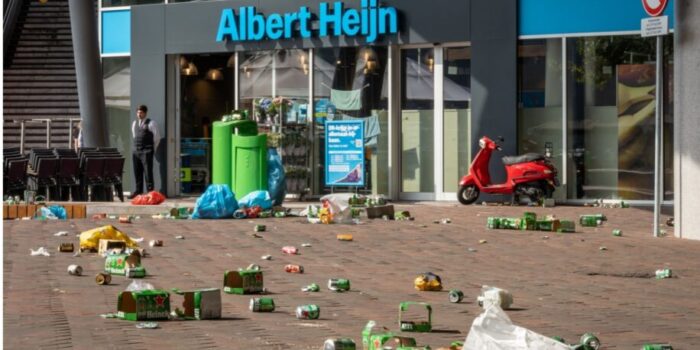
The other day I cycled through Amsterdam all day again and, honestly: I was absolutely horrified. What an unbelievable fucking mess — sorry, I can’t put it any more nicely — the streets are in. The city is littered with ripped-open garbage bags and emptied-out rubbish bins. The reason: the deposit refunds on cans and plastic bottles.

The website of Statiegeld Nederland keeps a tally, and the enthusiasm is palpable. Since June 2021 — the government introduced deposit refunds on small plastic bottles halfway through 2021 — 3,932,260,516 bottles and small bottles have already been returned. In 2023, deposit refunds on cans followed. According to the Dutch government, it is a good measure, because this would prevent the approximately 2 billion cans sold annually from ending up as litter on the streets.
Deposit refunds really add up
According to Statiegeld Nederland, research shows that 93% of people in the Netherlands already return cans and plastic bottles. Anyone who looks around Amsterdam can see that it is mainly homeless people and addicts who are busy returning them. No wonder either: for small plastic bottles, cans, and water and soft-drink bottles (up to 1 litre), you receive € 0.15 each. For large plastic bottles of soft drinks and water (from 1 litre), you even receive 25 cents each. Huge bags full of them really add up.
More litter on the streets instead
But the mood is not so celebratory everywhere in the deposit-refund chain. Supermarkets in busy areas complain bitterly that they can barely cope with taking returns. It also takes an enormous amount of time to clean the machines, because naturally all those cans leak sticky soft drink. At the Albert Heijn on Nieuwezijds Voorburgwal, for example, there are queues in the morning with a waiting time of at least half an hour, and often an hour.
And to collect those bottles and cans, garbage bags are ripped open and rubbish bins tipped over. Nuisance from litter has increased enormously, especially because of the deposit refunds on cans. So the deposit-refund measure has had the opposite effect. It is just no longer cans and plastic bottles lying in the street, but all the other rubbish. With one additional disadvantage: the nuisance caused by seagulls and rats.
This needs to change
The DoneerRing, an iron ring around rubbish bins where people can place their deposit bottles and cans, is a sympathetic initiative but far too small-scale and seems mainly intended to make searching for cans and bottles more humane. You can now find this ring in more than 100 German cities and in more than 20 municipalities in the Netherlands. The municipality of Amsterdam has also installed donation racks at 116 locations in the capital. But research shows that this, too, does not lead to less litter on the streets.
Amsterdam’s alderman for waste and cleaning, Hester van Buren, is at her wits’ end. In the past, collecting household-waste bags was sufficient; now the municipality of Amsterdam is spending millions of euros extra on street cleaning since the introduction of deposit refunds on cans and plastic bottles. This year alone, €13.5 million extra (!), according to fd.
Costs the municipality millions
For next year, Van Buren has budgeted an additional 10 million euros, on top of the standard 61 million euros reserved. That amount is intended solely for the street-sweeping crews and vehicles, emptying public rubbish bins, and the water sprayer used to blast the pavements clean. What a waste of money!
Meanwhile, more and more homeless people are finding their way to Amsterdam. With deposit refunds, you can earn enough money to get through the day. And to buy drugs. Apparently, drugs are also cheaper in Amsterdam than in other major world cities, so you understand: more drug users in the capital. As far as I’m concerned, the deposit-refund measure is a major flop. I’d say scrap the measure. And quickly.
The Netherlands is not the only country with deposit refunds on cans, incidentally; this is already the case in Germany, Finland, Norway and Denmark, among others.
Read also:
- Albert Heijn wants to print the CO2 consumption of your groceries on the receipt; isn’t that a little hypocritical?
- 10 products supermarket employees don’t know
- Drama: inflation is also hitting supermarket pizzas (and not just a little)


