


Did you know this: you should never reuse parchment paper
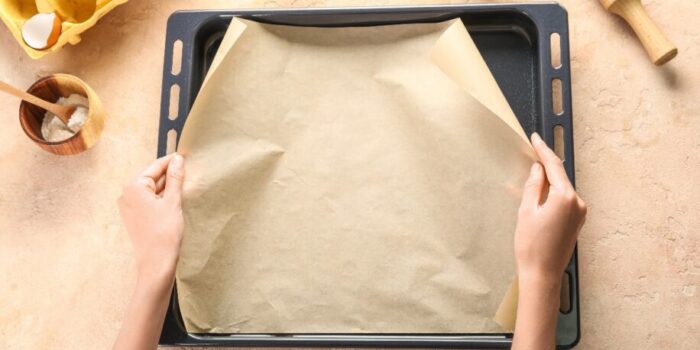
I’m a frugal type in the kitchen, mainly because I hate waste and carelessness when it comes to plastic, aluminum foil, and all kinds of packaging materials. That’s also why I was a devoted reuser of parchment paper. Until I read, uh-oh, why you’d better NOT reuse parchment paper…

It always seemed so harmless to me: you bake some cookies, see that hardly any baked-on residue is left on the parchment paper, simply fold it up, and the next time you take it out of the drawer again. Cookie dough on it, or pumpkin, parsnip, cauliflower—whatever you like for the tastiest roasted vegetables—and straight into the oven it goes. Good idea, right? Frugal and diligent, what more could you want.
Well—apparently, it’s not a good idea at all. Because here too, those darn PFAS chemicals can spoil the fun, just as with damaged nonstick pans.
PFAS coating containing harmful substances
Here’s the thing: many types of parchment paper have a coating of PFAS or silicone that is not safe for uses other than those intended by the manufacturer. “PFAS are chemical substances that, among other things, make parchment paper water- and grease-resistant. During normal use, hardly any of these substances are released into food. But at excessively high temperatures or when parchment paper is reused, these substances can be released in greater quantities.” This is according to toxicologist Joke Herremans, who works for the Waarzitwatin platform. As a consumer, you can turn to this independent source of information if you want to learn more about chemical substances in products we eat or use.
Never bake in Pop It toys
Many people think that reusing parchment paper cannot do any harm (39% of respondents in a study by Waarzitwatin). Or, just as bad, that it’s perfectly fine to bake in Pop It molds—popular children’s toys that are not intended to come into contact with food at all. You should be especially careful with silicone baking molds or silicone baking mats: when heated above 200° C, harmful substances can form unless otherwise indicated. To inform people about these dangers, but also to encourage them to think in terms of solutions, the platform offers five very useful tips. Incidentally, parchment paper without PFAS or silicone is also available; you just need to grease it beforehand.
5 tips for baking safely with less risk:
1. Do not set the oven higher than the maximum temperature of these baking products (parchment paper and silicone baking molds)
This is important for both products. Why? Substances contained in the baking mold or parchment paper can end up in the food. Especially when you set the oven to a very high temperature, undesirable substances can form. Therefore, never use the silicone baking mold above the temperature indicated by the manufacturer. Is no temperature indicated? Then never use the baking mold above 200 degrees Celsius, and never use parchment paper above 220 degrees. In the latter case, this also prevents the paper from catching fire and your freshly baked cookies from ending up in the trash.
2. Never place a baking tray with parchment paper loosely on it in the oven while preheating
This also creates a fire hazard. Make sure the paper does not touch the hot sides or heating elements either. That increases the chance of the paper burning.
3. Be careful when using aluminum foil as a substitute for parchment paper
Has the batter for the lemon cake just been mixed, or is the turkey ready to go, but you’re out of parchment paper? Don’t just use aluminum foil as an alternative. When combined with salty or acidic foods, small amounts of aluminum can get into the food. This can alter the taste of the food, but in the long term it can also be bad for your health.
4. Check whether your silicone mold is suitable for baking
“Proper” baking molds often display a “glass and fork symbol” or the words “suitable for contact with food.” If you want to bake with a silicone mold, choose one made of 100% silicone.
5. Pre-bake the silicone mold
Herremans recommends “pre-baking” the mold before using it for the first time. This removes residual siloxanes. These are substances in the silicone mold that are formed during manufacturing. How do you do this? First, wash the mold thoroughly with water and dish soap. Then fill the mold with water and oil. Next, place it in the oven for one hour at 220 degrees. (Note: when baking treats, silicone molds often may not be used at such a high temperature.) The silicone mold is then ready for use.
Source: waarzitwatin.nl. You’ll also find useful advice here about, for example, nonstick pans and bamboo tableware.
Also read:
- Fast-food packaging contains life-threatening PFAS
- Bad news: free compost turns out to be seriously contaminated
- RIVM warns: do not eat fish from the Westerschelde


